 Skip to content
Introduction
High-quality copper flat wire plays a critical role in modern electrical, automotive, and industrial applications. Its unique combination of dimensional precision, surface smoothness, and mechanical stability makes it ideal for applications that demand consistent electrical conductivity and mechanical reliability. The quality of copper flat wire begins with the wire drawing process, which ensures uniform diameter and optimal material properties. Properly drawn wire then undergoes flattening, annealing, and winding, resulting in a finished product suitable for high-performance industrial use. Understanding the specific requirements of different applications helps manufacturers select the right wire dimensions, tolerances, and production processes to meet functional and regulatory standards.
Electrical Industry Applications
Copper flat wire is widely used in electrical components where precision and conductivity are critical:
Motor Windings and Transformers
- Uniform thickness allows compact coil design and high current density.
- Tight thickness tolerance (±0.01 mm) reduces energy loss and ensures long-term reliability.
Connectors and Terminals
- Smooth surface minimizes contact resistance.
- Consistent dimensions improve assembly efficiency and electrical performance.
Flat wire enables high-frequency transformers and compact electrical devices to operate efficiently and reliably.

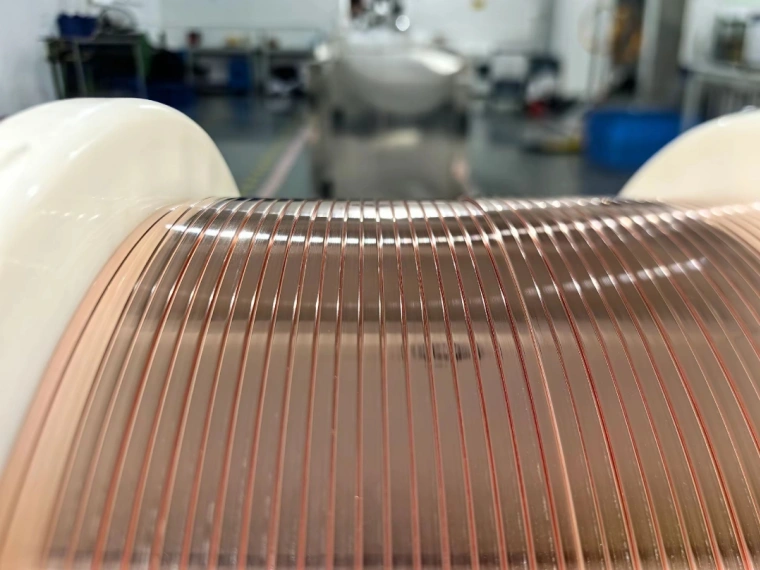
Automotive and Mechanical Applications
In automotive systems, copper flat wire must withstand mechanical stress, vibration, and thermal cycling while maintaining high electrical conductivity. Critical applications include battery tabs, connectors, precision clips, and sensor components. Key requirements and technical considerations are as follows:
Battery Tabs and Connectors
- Dimensional Accuracy: Thickness tolerance ±0.02 mm, width tolerance ±0.05 mm to ensure consistent electrical connectivity across multiple battery cells.
- Mechanical Strength: High ductility and tensile strength prevent cracks during repeated bending or compression in assembly and operation.
- Surface Quality: Smooth surfaces reduce contact resistance and prevent localized heating, ensuring reliable long-term performance.
Precision Clips and Sensor Components
- Width and Thickness Control: Accurate dimensions improve assembly fit and mechanical reliability, preventing misalignment or loose connections.
- Flexibility: Annealed copper flat wire maintains flexibility without compromising strength, allowing repeated bending or compression without failure.
- Material Stability: Controlled wire drawing and flattening processes ensure uniform microstructure, preventing brittle areas that could fail under vibration or load.
Quality at the wire drawing stage directly impacts downstream performance. Variations in diameter, surface finish, or mechanical properties can result in poor battery life, sensor failure, or connector malfunction. Optimized multi-stage wire drawing, flattening, and annealing, combined with inline monitoring, ensures the copper flat wire meets stringent automotive standards for both electrical efficiency and mechanical durability.
Industrial and Specialty Applications
Beyond electrical and automotive uses, copper flat wire finds applications in various industrial and specialty fields. In flexible circuits, thin copper flat wire allows designers to create compact, space-saving electronic assemblies without sacrificing conductivity. Aerospace components utilize flat wire for both mechanical and electrical purposes, where weight, reliability, and precision are critical. High-precision connectors, sensors, and specialized electrical equipment often require custom-shaped flat wire, including trapezoidal, double-flat, or irregular profiles, which are achievable with advanced dies and rolling systems. Inline monitoring of width, thickness, and surface finish is essential in these specialty applications to ensure the final product meets strict performance criteria.
Key Parameters and Technical Considerations
The successful application of copper flat wire depends on selecting the right combination of wire dimensions, tolerances, and mechanical properties. Typical parameters include:
Application | Width (mm) | Thickness (mm) | Tolerance | Notes |
Motor Windings | 1–12 | 0.1–2 | ±0.01 mm | Ensures coil efficiency |
Battery Tabs | 2–8 | 0.2–1.2 | ±0.02 mm | Withstands bending and vibration |
Flexible Circuits | 0.5–3 | 0.05–0.3 | ±0.01 mm | High conductivity for compact designs |
Aerospace | 1–10 | 0.1–1.5 | ±0.01 mm | Lightweight, precise, reliable |
The wire drawing machine must produce base wire with uniform diameter and surface quality to ensure that flattening, annealing, and winding can achieve precise final specifications. Variations in initial wire quality can result in defects such as uneven thickness, surface scratches, or inconsistent mechanical properties, which compromise performance in high-end applications.
Talk to Our Engineering Team
Copper flat wire quality is determined by the entire production process rather than a single machine. Stable wire drawing, precision flattening, controlled annealing, and automatic take-up must work together to achieve consistent dimensions, excellent surface quality, and reliable mechanical performance. By integrating these processes into one coordinated production line, manufacturers can improve productivity, reduce operating costs, and meet the demanding requirements of electrical, automotive, and industrial applications.
If you would like to learn more about flat wire manufacturing, explore our guides on the Copper Flat Wire Production Process and Wire Drawing Machine Selection. For customized flat wire production lines, contact Sky Bluer’s engineering team to discuss your material, finished wire specifications, production capacity, and automation requirements.