 Skip to content
What Is a Drawing Roller Cassette?
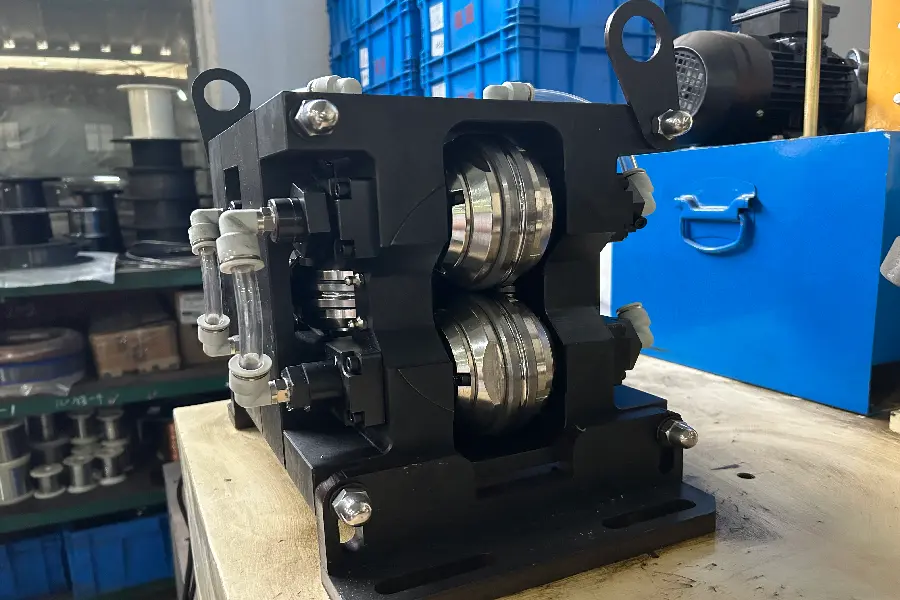
Drawing Roller Cassettes, also called Reduction Roller Cassettes, Roller Dies, or Wire Rolling Cassettes, are precision rolling units installed on conventional wire drawing machines to replace or supplement traditional tungsten carbide and diamond drawing dies.
Unlike conventional drawing dies that reduce wire diameter through frictional drawing, a drawing roller cassette deforms the material through controlled rolling contact. This significantly lowers drawing force, improves surface finish, extends die life, and reduces lubricant consumption.
Sky Bluer China designs customized drawing roller cassette systems for high-value materials including titanium alloys, stainless steel, copper alloys, nickel alloys, precious metals, medical wires, and aerospace superalloys.
Working Principle of a Drawing Roller Cassette
A drawing roller cassette reduces the wire cross-section through controlled rolling deformation rather than conventional sliding deformation. Four precision-ground rollers are arranged symmetrically around the wire, generating a balanced compressive stress field that minimizes eccentric loading during the reduction process. As the wire passes through the cassette, it is plastically deformed by rolling contact instead of being forced through a fixed die opening. This rolling mechanism significantly lowers the friction coefficient and decreases drawing force, heat generation, and surface shear compared with conventional wire drawing dies.
The deformation sequence is carefully designed to optimize metal flow. During the first pass, the incoming round wire is gradually transformed into an oval profile, allowing plastic strain to be distributed more uniformly across the cross-section while relieving localized stress concentration. In the subsequent pass, the oval section is recalibrated into a round profile, producing the required finished diameter with high dimensional accuracy and concentricity. Because the deformation is achieved through progressive rolling rather than severe sliding, the material experiences a more homogeneous strain distribution, resulting in reduced residual stress, improved grain flow continuity, and superior surface integrity.
The rolling reduction mechanism is particularly advantageous for high-strength and difficult-to-deform materials such as titanium alloys, nickel-based superalloys, stainless steel, and precipitation-hardened alloys. By reducing localized deformation resistance and minimizing surface damage, the drawing roller cassette extends tool life, improves process stability, and enables higher-quality wire production with tighter dimensional tolerances than conventional die drawing.
Compared with conventional dies, roller reduction generates:
- Lower deformation resistance
- Reduced drawing force
- Lower wire temperature
- Better lubrication
- Improved grain flow
- Superior dimensional consistency
Advantages of Roller Drawing Compared with Conventional Drawing Dies
| Parameter | Drawing Die | Drawing Roller Cassette |
| Contact Type | Sliding Friction | Rolling Contact |
| Drawing Force | High | 20–40% Lower |
| Lubrication Consumption | High | Low |
| Wire Surface | Moderate | Excellent |
| Die Wear | Fast | Very Low |
| Service Life | Standard | 3–10× Longer |
| Heat Generation | High | Low |
| Surface Scratches | Possible | Significantly Reduced |
| Suitable for Titanium | Limited | Excellent |
| Suitable for Superalloys | Difficult | Excellent |
Typical Technical Specifications
Mechanical Specifications
| Item | Typical Value |
| Roller Quantity | 4 Rollers |
| Roller Arrangement | Cross Type |
| Roller Material | Tungsten Carbide / Tool Steel / Ceramic (Optional) |
| Roller Hardness | HRA 90–93 |
| Roller Surface Roughness | Ra ≤0.05 μm |
| Roller Runout | ≤0.002 mm |
| Bearing Type | Precision Angular Contact Bearings |
| Lubrication | Grease or Oil |
| Cooling | Optional Water Cooling |
| Rotation | Passive or Driven |
| Mounting Type | Horizontal / Vertical |
| Frame Material | High Strength Alloy Steel |
Wire Processing Capacity
| Parameter | Typical Range |
| Incoming Wire Diameter | 0.15–12 mm |
| Finished Diameter | 0.05–10 mm |
| Single Pass Reduction | 2–50% |
| Diameter Tolerance | ±0.002–0.01 mm |
| Surface Finish | Ra 0.05–0.20 μm |
| Maximum Drawing Speed | Up to 800 m/min* |
| Temperature Rise | Much Lower than Die Drawing |
Depending on wire material and machine configuration.
Recommended Reduction Rate by Material
| Material | Typical Reduction |
| Copper | 30–45% |
| Aluminum | 30–45% |
| Brass | 20–40% |
| Carbon Steel | 15–30% |
| Stainless Steel | 10–25% |
| Titanium | 8–20% |
| Nickel Alloy | 10–20% |
| Nitinol | 5–15% |
| Tungsten | 5–12% |
Materials Suitable for Roller Drawing
Sky Bluer drawing roller cassettes are widely used for processing:
Titanium Alloys
- Grade 1
- Grade 2
- Grade 5 (Ti-6Al-4V)
Nickel Alloys
- Inconel
- Monel
- Hastelloy
- Waspaloy
- Haynes 25
Medical Alloys

- Nitinol
- Titanium Medical Wire
- Stainless Medical Wire
Stainless Steel
- 201
- 304
- 304L
- 316L
- 310S
- Duplex Stainless
Copper Materials
- OFHC Copper
- Oxygen-Free Copper
- Silver Bearing Copper
- Brass
- Bronze
Steel Materials
- High Carbon Steel
- Low Carbon Steel
- Spring Steel
- Flux Cored Wire
Precision Performance
Modern drawing roller cassettes are capable of achieving:
| Performance | Value |
| Diameter Consistency | ±0.002 mm |
| Roundness | ≤0.003 mm |
| Straightness | Excellent |
| Surface Finish | Ra 0.05 μm |
| Vibration | Very Low |
| Concentricity | ≥99.8% |
Roller Materials
Different materials require different roller hardness.
| Roller Material | Application |
| Tungsten Carbide | Stainless Steel |
| Ceramic | Copper & Precious Metals |
| Powder Metallurgy Steel | Titanium |
| Tool Steel | Carbon Steel |
| Coated Rollers | High Temperature Alloys |
Compatible Wire Drawing Machines
Sky Bluer roller cassettes can be integrated with:
- Wet Wire Drawing Machine
- Dry Wire Drawing Machine
- Fine Wire Drawing Machine
- Medium Wire Drawing Machine
- Heavy Wire Drawing Machine
- Multi-pass Drawing Line
- Continuous Wire Drawing Machine
- Bull Block Drawing Machine
- Straight Line Wire Drawing Machine
Custom adapters can be manufactured for nearly all international wire drawing machine brands.
Installation Requirements
Before manufacturing, Sky Bluer recommends providing:
- Machine layout drawing
- Mounting dimensions
- Wire center height
- Motor direction
- Drawing speed
- Capstan diameter
- Wire material
- Tensile strength
- Lubrication type
- Required reduction
- Finished diameter
This information enables engineers to design a cassette with the correct roller geometry and mounting interface.
Maintenance Schedule
| Maintenance Item | Interval |
| Clean Rollers | Daily |
| Check Bearings | Weekly |
| Inspect Roller Wear | Monthly |
| Measure Roller Runout | Every 3 Months |
| Regrind Rollers | Every 6–12 Months |
| Bearing Replacement | 12–24 Months |
Typical Production Process of a Drawing Roller Cassette
A standard wire drawing line using a drawing roller cassette typically consists of a pay-off unit, wire cleaning system, lubrication device, drawing roller cassette, optional drawing die, capstan, inline laser diameter gauge, and take-up unit. The wire is first unwound from the pay-off and cleaned to remove oxides and contaminants. After lubrication, it enters the drawing roller cassette, where precision rollers gradually reduce the wire cross-section through rolling rather than sliding friction. When tighter dimensional tolerances or additional reduction are required, a conventional drawing die can be installed downstream of the cassette. The capstan maintains stable drawing tension, while the laser diameter gauge continuously measures the finished wire diameter for real-time quality control. Finally, the wire is collected by the take-up system with consistent tension, ensuring excellent coil quality and readiness for subsequent manufacturing processes.
Typical Applications of Rolling Cassettes
Drawing roller cassettes are widely used in:
- Aerospace Wire
- Medical Guidewire
- Surgical Wire
- Orthodontic Wire
- Battery Tab Wire
- EV Motor Wire
- Welding Wire
- Flux Cored Wire
- Titanium Wire
- Nitinol Wire
- Stainless Steel Wire
- Copper Wire
- Precious Metal Wire
- High Temperature Alloy Wire
Why Choose Sky Bluer Drawing Roller Cassettes?
Sky Bluer China has extensive experience in designing customized reduction roller cassettes for precision wire manufacturing. Every cassette is engineered according to the customer’s wire material, incoming diameter, finished diameter, tensile strength, and production speed.
Our engineering team provides:
- Customized roller pass design
- Finite element deformation analysis
- Precision roller grinding
- Installation support
- Sample testing before delivery
- Technical process optimization
- Long-term spare parts service
Whether you are processing titanium, nickel alloys, stainless steel, copper, or specialty materials, Sky Bluer can develop a roller cassette solution that improves wire quality, reduces production costs, and extends equipment life.