Copper Wire Drawing for Magnet Wire Manufacturing: The Complete Technical Guide
Introduction: The Role of Wire Drawing in Modern Copper Conductor Manufacturing Copper wire drawing is one of the most important processes in precision copper conductor
Yangshe Town,Suzhou City,Jiangsu,China 215600
Wire drawing machines play a vital role in precision metal processing. They enable manufacturers to produce high-accuracy wire for industries such as electrical, automotive, medical, and semiconductor. By continuously reducing wire diameter through controlled deformation, these systems deliver consistent quality, tight tolerances, and high production efficiency.
In this guide, we explain how wire drawing machines work, how they integrate with rolling systems for flat and shaped wire production, and how to select the right machine configuration for your application.

Introduction: The Role of Wire Drawing in Modern Copper Conductor Manufacturing Copper wire drawing is one of the most important processes in precision copper conductor

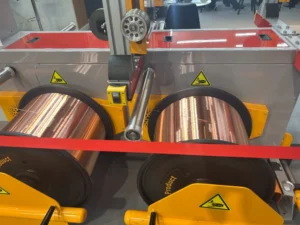
Understand the essential components of a shaped wire drawing machine and how to choose the right equipment for precision flat, shaped, and profile wire production.

Introduction Flat rectangular and special profile wire manufacturers always debate two mainstream cold forming technologies: die-based shaped wire drawing and roller-based flat wire rolling. Each

Learn how a complete shaped wire drawing production line is designed, from wire pay-off and drawing to rolling, annealing, take-up, and quality inspection.

Introduction Many metal processing factories waste budget on mismatched shaped wire drawing machines: purchasing high-precision wet equipment for thick carbon steel wire, or low-spec dry

This article briefly explains lubrication system selection in titanium wire drawing, covering cold and hot drawing, and how lubricant type is determined by titanium grade, wire diameter, and process temperature to ensure stable performance and surface quality.

Titanium wire surface stripping system (peeling/descaling system) integrated in wire drawing production lines for stable surface control, improved drawing performance, and consistent annealing and forming quality based on material grade and process requirements.

This page explains the engineering principles of titanium wire annealing system integration in wire drawing production lines. It covers material-specific selection for Gr1, Gr2, and TC4 titanium, system configuration options including continuous, bright, and vacuum annealing, and key process parameters such as temperature control, atmosphere protection, and tension synchronization. The content is intended to guide production line design and equipment selection for industrial titanium wire manufacturing.

Introduction Fine titanium wire production is not simply a continuation of standard drawing reduction. Once the wire diameter enters the sub-millimeter range, the process behavior