 Skip to content
A wire payoff machine is the first controlled section of a complete wire drawing or forming line. It unwinds wire from a spool, reel or coil and feeds it into the downstream process with stable tension, correct alignment and controlled speed.
The payoff system is used before wire drawing, rolling, flattening, shaping, coating, stranding and annealing equipment. Its performance directly affects die life, drawing force, wire surface quality, dimensional stability and production continuity.
A payoff machine should therefore be designed according to the actual wire geometry, material strength, coil format, production speed and downstream process.
What Is a Wire Payoff Machine?
A wire payoff machine receives incoming wire from a coil, spool or reel and delivers it continuously to the next production stage.
Its main functions include:
- Unwinding wire without tangling
- Maintaining stable entry tension
- Controlling wire alignment
- Synchronizing speed with the drawing line
- Preventing twisting and surface damage
- Supporting different coil and reel formats
- Allowing safe loading and unloading
- Maintaining stable operation during acceleration and stopping
The correct payoff configuration depends on whether the line processes round wire, square wire, flat wire, rectangular wire or a custom-shaped profile.
Wire Payoff Machine Technical Parameters
| Parameter | Typical engineering range or specification |
| Wire diameter | Approximately 0.02–20 mm |
| Wire profiles | Round, square, flat, rectangular and shaped wire |
| Wire materials | Copper, aluminium, stainless steel, carbon steel and alloys |
| Coil or reel weight | Approximately 20–2,000 kg |
| Reel diameter | Approximately 300–1,600 mm |
| Reel core diameter | Approximately 100–600 mm |
| Payoff speed | Approximately 50–600 m/min |
| Entry tension | Project-specific and material-dependent |
| Drive configuration | Passive brake, AC motor, servo motor or torque-controlled drive |
| Shaft configuration | Fixed shaft, expanding shaft or interchangeable mandrel |
| Installation type | Floor-mounted or overhead |
| Control system | PLC, HMI, encoder feedback and alarm monitoring |
| Safety functions | Guarding, emergency stop, overspeed and reel detection |
These values are typical engineering references. The final parameters should be confirmed according to the actual wire specification, line speed, reel weight and factory layout.
How the Payoff Fits into a Wire Drawing Line
A complete wire drawing line may include:
- Wire payoff
- Straightening or de-looping unit
- Cleaning or surface preparation
- Drawing dies and die boxes
- Drawing blocks or capstans
- Lubrication and cooling
- Intermediate or final annealing
- Online diameter measurement
- Wire take-up system
The payoff is the first mechanical interface between the incoming material and the drawing process. Poor entry control can create problems that appear later as:
- Wire breaks
- Uneven die wear
- Diameter variation
- Surface scratches
- Excessive drawing force
- Unstable tension
- Coil tangling
Passive Wire Payoff Machines
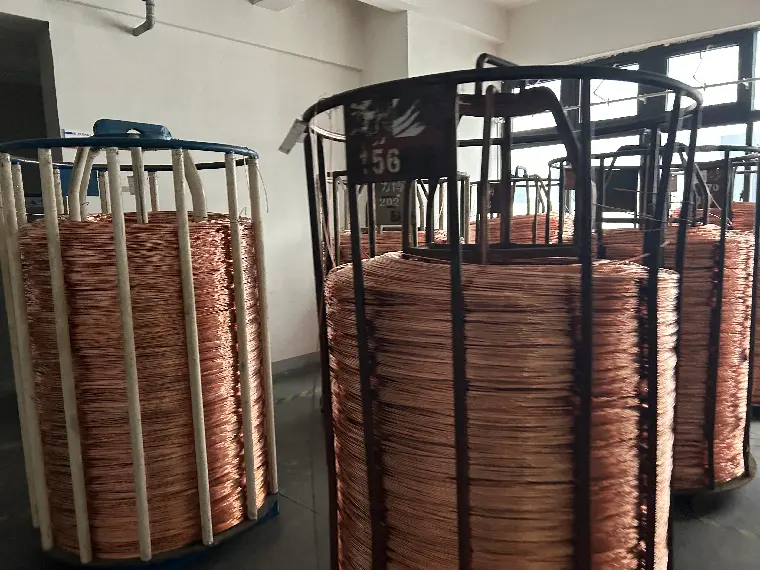
Passive payoff machines do not use an independent motor. The downstream drawing machine or rolling mill pulls the wire from the coil.
Main Features
- Simple mechanical structure
- No independent drive motor
- Low energy consumption
- Low maintenance requirement
- Suitable for stable production conditions
- Lower initial equipment cost
Passive payoff systems normally use a mechanical brake or adjustable resistance device to prevent coil overspeed.
They are suitable for:
- Standard round-wire drawing lines
- Low- and medium-speed production
- Stable copper-wire processing
- Carbon steel and stainless steel wire
- Basic rolling and flattening lines
Active Wire Payoff Machines
Active payoff machines use a motor and drive system to release the wire.
Main Features
- Motorized unwinding
- Active tension control
- Speed synchronization
- Controlled acceleration and deceleration
- Better response during line-speed changes
- Suitable for precision and high-speed production
An active payoff may include:
- AC vector drive
- Servo motor
- Torque-control mode
- Dancer roll
- Load-cell feedback
- Encoder synchronization
- Automatic reel-diameter compensation
Active payoffs are recommended when the wire must enter the first die or forming stand with a controlled tension range.
Expanding Shaft Wire Payoff Machines
Expanding shaft payoffs hold the reel by expanding inside the spool core.
| Feature | Engineering benefit |
| Adjustable shaft diameter | Supports multiple reel core sizes |
| Positive reel locking | Prevents spool slip during acceleration |
| Rigid shaft support | Reduces vibration and runout |
| Motorized rotation | Enables active speed control |
| Quick reel loading | Reduces changeover time |
| Heavy-duty bearings | Supports large package weights |
The expanding shaft should be selected according to reel weight, maximum speed, braking torque and emergency-stop requirements.
Round Wire Payoff Machines
Round wire is widely used in drawing, rolling, coating and stranding lines.
Typical materials include:
- Copper wire
- Aluminium wire
- Stainless steel wire
- Carbon steel wire
- Alloy steel wire
- Welding wire
- Fine and ultra-fine wire
Round-wire payoff systems should provide:
- Stable centerline alignment
- Controlled brake torque
- Smooth coil release
- Reduced wire twisting
- Low-friction guides
- Stable entry tension
For fine wire, the reel should have low rotational inertia and the wire guides should be polished, wear-resistant and correctly aligned.
Square Wire Payoff Machines
Square wire must enter the drawing or rolling section with its orientation maintained.
Important design requirements include:
- Anti-rotation guide rollers
- Profile-compatible ceramic guides
- Controlled lateral movement
- Stable reel alignment
- Corner protection
- Low-impact wire handling
Incorrect orientation may change the corner radius, surface contact area and final dimensional accuracy.
Flat and Rectangular Wire Payoff Machines
Flat and rectangular wire is more sensitive to edge damage, twisting and excessive contact pressure than round wire.
| Requirement | Flat and rectangular wire solution |
| Edge protection | Ceramic or polished profile guides |
| Orientation control | Anti-twist roller arrangement |
| Surface protection | Low-contact-pressure wire path |
| Width stability | Controlled lateral alignment |
| Tension control | Dancer or load-cell feedback |
| Bending control | Large-radius guide rollers |
| Downstream matching | Profile-specific entry guide |
These systems are suitable for:
- Flat copper wire
- Stainless steel flat wire
- Spring steel wire
- Magnet wire
- Rectangular conductor
- PV ribbon
- Flat profile wire
Shaped and Profile Wire Payoff Machines
Shaped wire requires a payoff system designed around its cross-section.
Suitable profiles may include:
- Wedge-shaped wire
- Triangular wire
- Trapezoidal wire
- Half-round wire
- Custom profile wire
- Special support wire
The system may include:
- Customized wire guides
- Profile-specific rollers
- Anti-twist assemblies
- Orientation control
- Low-contact-pressure surfaces
- Special spool geometry
- Controlled minimum bending radius
The final design should be based on the wire drawing, profile drawing, incoming coil dimensions and required orientation at the first forming stage.

Wire Payoff Tension Control
Entry tension is one of the most important payoff parameters.
| Tension condition | Typical production result |
| Excessive tension | Wire stretching, diameter variation and breakage |
| Low tension | Loops, vibration and unstable die entry |
| Periodic tension fluctuation | Repeating surface or dimensional defects |
| Sudden tension peak | Wire break during acceleration |
| Uncontrolled reel inertia | Overspeed and coil collapse |
Possible tension-control components include:
- Mechanical brake
- Magnetic brake
- Pneumatic brake
- Dancer roll
- Load cell
- Servo motor
- Torque-controlled drive
- Accumulator
The tension system must be tested during start-up, speed changes, reel replacement and emergency stops.
Payoff Drive and Speed Synchronization
The payoff drive must match the downstream drawing or rolling speed while compensating for changing coil diameter.
The control system should provide:
- Speed reference from the main line
- Torque limitation
- Acceleration and deceleration ramps
- Reel-diameter compensation
- Overspeed protection
- Emergency braking
- Encoder feedback
- PLC communication
The drive should be tested under full-reel and empty-reel conditions. A system that performs correctly with a small coil may become unstable when the reel inertia increases.
Wire Alignment and Entry Guide Design
The entry guide controls the wire centerline before the first die or rolling stand.
The following items should be checked:
- Guide concentricity
- Guide wear
- Wire center height
- Coil position
- Lateral movement
- Vertical movement
- Minimum bending radius
- Surface cleanliness
- Profile orientation
For square, flat and shaped wire, the guide must prevent profile rotation before forming.
Wire Payoff Applications
Wire payoff systems are used before:
- Wire drawing machines
- Straight-line drawing machines
- Fine-wire drawing lines
- Wire rolling mills
- Flattening machines
- Shaped-wire production lines
- Coating and insulation lines
- Cable stranding equipment
- Annealing lines
- Automated wire-processing equipment
Industries include:
- Electrical manufacturing
- Automotive wiring
- Telecommunications
- Solar and photovoltaic production
- Construction wire
- Medical wire
- Aerospace and defence
- Industrial cable manufacturing
Common Wire Payoff Problems and Solutions
| Problem | Likely cause | Corrective action |
| Wire loops before the die | Insufficient braking or high reel inertia | Adjust brake torque and add dancer control |
| Coil keeps rotating after line stop | Inadequate braking response | Check brake capacity and stop logic |
| Surface scratches | Damaged or misaligned guide | Replace guide and correct wire path |
| Wire break at start-up | Excessive acceleration or entry tension | Reduce ramp rate and tune tension control |
| Drawing force fluctuation | Payoff and drawing speed mismatch | Synchronize the drives |
| Coil tangling | Poor coil formation or wrong wire path | Improve coil handling and entry guidance |
| Reel vibration | Imbalance or poor shaft centering | Check reel runout, shaft and bearings |
| Profile twisting | Incorrect guide layout | Add orientation and anti-twist control |
Payoff Machine Safety and Maintenance
A production payoff should include:
- Emergency-stop pushbuttons
- Reel guards
- Overspeed protection
- Reel-presence detection
- Shaft-lock confirmation
- Brake monitoring
- Mechanical end stops
- Safe lifting points
- Protection around rotating parts
Routine maintenance should include:
- Brake inspection
- Shaft and bearing inspection
- Guide replacement
- Reel-centering verification
- Sensor calibration
- Encoder inspection
- Electrical cabinet checks
- Emergency-stop testing
Wire Payoff Acceptance Tests
The payoff should be tested using the customer’s actual wire, coil and reel.
| Acceptance test | Main evaluation |
| Empty-reel operation | Smooth rotation and controlled braking |
| Full-reel operation | Stable torque and low vibration |
| Speed synchronization | No slack wire or excessive pulling force |
| Tension test | Stable entry tension |
| Acceleration test | No tension spike or wire break |
| Emergency-stop test | Safe and controlled stopping |
| Guide alignment test | Correct wire centerline |
| Reel-change test | Safe and efficient loading |
| Continuous operation test | Stable feeding over the required production period |
Information Required for Payoff Machine Design
A technical inquiry should include:
- Wire material and grade
- Round, square, flat or shaped profile
- Incoming wire diameter or dimensions
- Coil and reel dimensions
- Maximum package weight
- Reel core diameter
- Required production speed
- Target entry tension
- Downstream drawing or rolling machine
- Floor or overhead installation
- Reel loading method
- Automation requirements
- Electrical and safety standards
- Available factory space
This information is required to select the correct frame, shaft, brake, motor, guide, bearing and control system.
Wire Payoff Machines for Complete Drawing Lines
A payoff machine is the first process-control point in a wire drawing line. Its performance influences wire tension, die life, surface quality, profile orientation and overall production efficiency.
Sky Bluer designs payoff systems for round wire, square wire, flat wire, rectangular wire and shaped wire, including copper, aluminium, stainless steel, carbon steel and alloy materials.
The final configuration is matched to the incoming coil, material strength, line speed, tension requirement, downstream forming process and factory layout.