In the evolving landscape of precision metalworking, wire is more than a simple conduit of material; it is a critical component whose shape, surface quality, and dimensional accuracy determine product performance in industries ranging from energy and automotive to medical and electronics. Transforming round wire into flat, square, or specially contoured profiles requires more than traditional rolling. It requires advanced technology, a deep understanding of material behavior, and equipment engineered for reliability and precision.
At Sky Bluer China, we recognize these demands and have developed a range of wire flattening and shaping technologies that respond directly to the needs of modern manufacturers. Our systems are designed to deliver consistent dimensional control, superior surface quality, stable process performance, and long-term production reliability.
The Role of Flat, Square, and Custom Wire in Modern Applications

Flat wire plays a foundational role in many applications, particularly where space is limited and performance demands are high. In transformer winding applications, for example, flat copper conductors improve space utilization and reduce electrical losses. In stainless steel components, flat and edge-controlled strips provide structural integrity and ease of assembly. Square or custom-profiled wires are essential in medical devices, orthodontics, and precision engineering, where surface finish and geometric precision are critical.
Machine Architecture as the Foundation of Precision

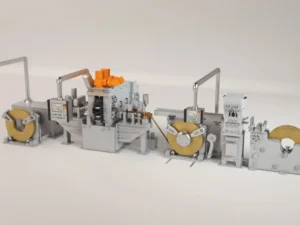
The heart of advanced wire flattening technology is a machine architecture that balances rigidity and adaptability. A robust mechanical frame supports stable roll pressure and minimizes vibration, ensuring uniform deformation of the wire throughout the production process. Precision roll tooling, crafted from wear-resistant materials such as hardened alloy steels or tungsten carbide, maintains consistent geometry and prolongs service life even under the stress of continuous operation. Together, these elements form the foundation for dimensional accuracy and repeatability.
Multi-Stage Deformation and Intelligent Control

Controlling the deformation process in multiple stages allows for gradual shaping of the wire without introducing undue internal stress. Sky Bluer China’s multi-stand lines are engineered to handle a wide range of materials, from highly conductive copper to high-strength stainless steels and shape-memory alloys like nickel-titanium (NiTi). Intelligent control systems monitor and adjust roll gap, tension, and alignment in real time, enabling stable operation and consistent output. These automated features not only improve precision but reduce the need for manual intervention, making the process more efficient and dependable from batch to batch.
Copper Flat Wire Rolling Mills for Electrical Applications

One of our core offerings is the copper flat wire rolling mill, a machine designed specifically for transformer and electrical applications where conductor geometry and surface quality are paramount. These mills produce finished widths ranging from 2 to 20 millimeters and thicknesses from 0.1 to 1.2 millimeters, with tolerances maintained within narrow bands to ensure predictable performance in high-voltage and power distribution systems. The control systems built into these lines maintain flatness and geometry even at higher speeds, enabling manufacturers to meet production targets without sacrificing quality.
Stainless Steel Edge Flat Strip Production Lines

For stainless steel applications, our edge flat strip production lines transform round or rectangular wire into profiles with finished widths between 3 and 30 millimeters and thicknesses up to 2.5 millimeters. These systems are engineered to control edge quality and strip flatness, features that are especially important for parts that will be formed, welded, or assembled in downstream operations. The careful integration of roll configuration and tension control enhances surface finish and reduces edge defects, improving overall product quality and process yield.
Nickel-Titanium (NiTi) Square Wire Production Lines
Specialized applications require equally specialized solutions. In the case of nickel-titanium square wire production lines, the unique properties of NiTi alloys demand precise control throughout shaping. These lines produce square cross-sections from 0.3 to 2.0 millimeters with tight dimensional tolerances. By carefully managing deformation and thermal conditions, Sky Bluer China’s NiTi lines achieve geometry that meets the exacting requirements of medical devices and orthodontic components, where surface and mechanical integrity are essential.
Turks Head Wire Flattening Mills for Custom Profiles

Beyond traditional flat and square profiles, there are applications that call for bespoke shapes. Our Turks head wire flattening mills offer multi-directional shaping capability through four-roll configurations that enable flat, square, and custom-shaped output. These systems are valued where geometric symmetry and complex profiles must be maintained for functional or aesthetic reasons.
Compact and Integrated Wire Flattening Solutions
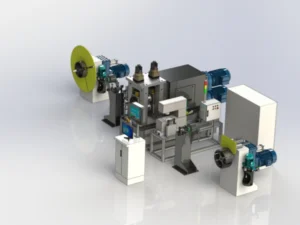
Not all production environments require large, fully dedicated lines. Many customers benefit from compact, integrated units that bring flattening, guiding, and take-up together in a space-efficient footprint. These systems can be customized to integrate seamlessly with upstream drawing machines, intermediate processing such as annealing, and downstream coating or winding equipment. Through this level of integration, manufacturers can maintain a continuous and controlled process flow from raw coil to finished wire profile.
Engineering Value Beyond the Machine
Across all these technologies, the advantage lies not just in the machine itself but in the combination of engineering insight and practical design. Whether the goal is to improve surface quality, control profile geometry, or maximize throughput, Sky Bluer China’s solutions are engineered to deliver. By focusing on quality and precision, manufacturers can reduce production costs, minimize scrap, and enhance the overall performance of their products.
Conclusion
In industries where specifications are tight and performance expectations are high, mastering wire flattening technology is essential. From copper conductors used in transformer cores to the stainless steel strips in precision assemblies and the square NiTi wires in medical applications, every profile tells a story of engineered precision. At Sky Bluer China, we are committed to advancing that technology, delivering equipment that meets today’s challenges and tomorrow’s demands.
Contact Sky Bluer China
- Phone / WhatsApp: +86 136 4191 9128
- Email: drawingmachine66@gmail.com
- Address: Suzhou City & Zhangjiagang City, Jiangsu Province, China