 Skip to content
Complete Stainless Steel Strip Production Process
Stainless steel strip is one of the most important precision materials used in modern manufacturing. It is widely applied in electronics, automotive components, battery systems, medical devices, precision springs, industrial seals, aerospace parts, and household appliances. The quality of stainless steel strip depends largely on the rolling process, which determines thickness accuracy, surface finish, flatness, hardness, and mechanical properties.
Stainless steel strip production combines hot rolling, pickling, cold rolling, annealing, tension leveling, and precision slitting to achieve extremely tight dimensional tolerances. In high-end applications such as connector materials, battery tabs, and precision springs, thickness tolerances can reach ±0.001 mm.
This article explains the complete stainless steel strip rolling process, rolling mill configurations, process parameters, reduction schedules, and key factors affecting strip quality.
Stainless Steel Grades Commonly Used for Strip Rolling
The rolling behavior of stainless steel depends significantly on the material grade.
| Grade | Type | Tensile Strength (MPa) | Typical Applications |
| AISI 201 | Austenitic | 520-750 | Decorative strip, appliances |
| AISI 301 | Austenitic | 520-850 | Precision springs |
| AISI 304 | Austenitic | 520-720 | General precision strip |
| AISI 304L | Austenitic | 500-700 | Corrosion-resistant strip |
| AISI 316L | Austenitic | 520-720 | Medical and marine applications |
| AISI 321 | Austenitic | 520-720 | High-temperature applications |
| AISI 410 | Martensitic | 700-950 | Blades and wear-resistant components |
| AISI 430 | Ferritic | 450-650 | Household appliances |
Different grades require different rolling forces, reduction schedules, and annealing conditions.
Complete Stainless Steel Strip Manufacturing Process
The production of stainless steel strip typically includes steelmaking, continuous casting, hot rolling, pickling, cold rolling, intermediate annealing, precision rolling, tension leveling, slitting, inspection, and packaging. Each stage is carefully controlled to achieve the required thickness tolerance, surface finish, flatness, and mechanical properties, ensuring the final strip meets the demands of precision industrial applications.

Hot Rolling Process
Hot rolling is the first major deformation process after casting.
The slab is heated above its recrystallization temperature and passed through multiple rolling stands to reduce thickness.
Typical hot rolling parameters are shown below.
| Parameter | Typical Range |
| Slab Thickness | 150-250 mm |
| Reheating Temperature | 1100-1250°C |
| Finishing Temperature | 850-950°C |
| Entry Thickness | 150-250 mm |
| Exit Thickness | 2.0-8.0 mm |
| Rolling Speed | 3-20 m/s |
| Coil Weight | 5-30 tons |
The primary objectives of hot rolling are:
Reducing slab thickness
Refining grain structure
Improving material uniformity
Producing feedstock for cold rolling
Pickling Process
After hot rolling, oxide scale forms on the strip surface.
Before cold rolling, this scale must be removed.
Typical pickling solutions include:
| Pickling Solution | Application |
| Nitric Acid + Hydrofluoric Acid | Austenitic stainless steel |
| Sulfuric Acid | General descaling |
| Mixed Acid Systems | Precision strip production |
Proper pickling prevents roll damage and improves surface quality during cold rolling.
Cold Rolling Process
Cold rolling is the most important stage in precision strip manufacturing.
Unlike hot rolling, cold rolling is performed at room temperature.
The strip passes through precision rolling mills where thickness is reduced incrementally.
Benefits include:
Higher dimensional accuracy
Improved surface finish
Increased strength through work hardening
Superior flatness
Better thickness consistency
Typical cold rolling parameters:
| Parameter | Typical Range |
| Entry Thickness | 2.0-6.0 mm |
| Final Thickness | 0.02-2.0 mm |
| Rolling Speed | 50-800 m/min |
| Reduction Per Pass | 15-40% |
| Strip Width | 5-650 mm |
| Thickness Tolerance | ±0.001 to ±0.01 mm |
Thickness Reduction Schedule
A typical rolling schedule for stainless steel strip is shown below.
| Pass | Thickness (mm) |
| Hot Rolled Coil | 3.00 |
| Pass 1 | 2.40 |
| Pass 2 | 1.92 |
| Pass 3 | 1.54 |
| Annealing | — |
| Pass 4 | 1.20 |
| Pass 5 | 0.95 |
| Pass 6 | 0.75 |
| Final Product | 0.60 |
Total reduction may exceed 80%.
For precision spring strip and battery materials, reductions above 90% are common.
Rolling Force Calculation
Rolling force determines mill design requirements and motor selection.
The simplified rolling force equation is:
F = k × b × L × σ
Where:
F = Rolling Force
b = Strip Width
L = Contact Length
σ = Average Flow Stress
k = Material Coefficient
Typical rolling forces:
| Strip Width | Thickness Reduction | Rolling Force |
| 50 mm | 20% | 100-300 kN |
| 100 mm | 20% | 200-600 kN |
| 300 mm | 30% | 600-2000 kN |
| 600 mm | 30% | 1500-5000 kN |
Higher rolling forces require greater mill rigidity and more powerful drive systems.
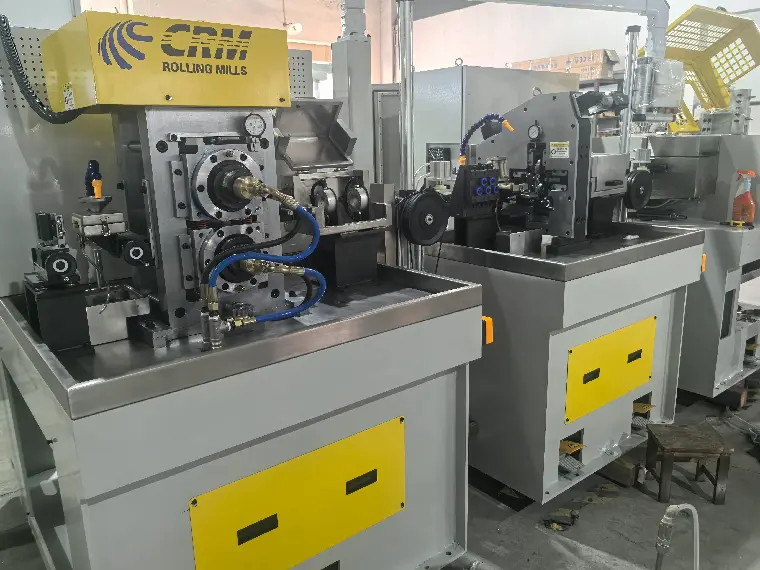
Types of Stainless Steel Rolling Mills
2-High Rolling Mill
The simplest mill configuration.
Features:
High rigidity
Simple maintenance
Lower investment cost
Suitable for medium-thickness strip production
Typical specifications:
| Parameter | Range |
| Roll Diameter | 150-400 mm |
| Strip Width | 10-300 mm |
| Final Thickness | 0.20-3.00 mm |
| Speed | 50-300 m/min |
4-High Rolling Mill
The most widely used configuration for precision strip production.
Features:
Reduced roll deflection
Improved thickness accuracy
Higher rolling force capability
Better strip flatness
Typical specifications:
| Parameter | Range |
| Work Roll Diameter | 50-200 mm |
| Backup Roll Diameter | 300-800 mm |
| Strip Width | 20-650 mm |
| Final Thickness | 0.03-2.00 mm |
| Speed | 100-800 m/min |
Multi-Roll Mill
Used for ultra-thin precision strip.
Features:
Exceptional rigidity
Ultra-high precision
Extremely thin strip production
Typical specifications:
| Parameter | Range |
| Final Thickness | 0.01-0.20 mm |
| Thickness Tolerance | ±0.001 mm |
| Width Range | 5-300 mm |
| Rolling Speed | 100-600 m/min |
Multi-roll mills are commonly used for connector materials, battery tabs, and electronic precision alloys.
Flat Wire Rolling and Wire Flattening Technology
For many applications, round wire must be converted into flat wire before use.
This process is performed using precision wire flattening mills.
Typical applications include:
Flat spring wire
Battery connector materials
Electrical contact materials
Precision electronic components
Typical flattening parameters:
| Parameter | Range |
| Round Wire Diameter | 0.3-8.0 mm |
| Flat Wire Width | 0.5-20 mm |
| Flat Wire Thickness | 0.05-5.0 mm |
| Thickness Tolerance | ±0.002-0.01 mm |
Compared with conventional strip rolling, wire flattening offers higher material utilization and lower production costs for narrow-width products.
Annealing Process
During cold rolling, stainless steel becomes progressively harder due to work hardening.
Intermediate annealing restores ductility and allows further reduction.
Typical annealing parameters:
| Grade | Annealing Temperature |
| 301 | 1050-1100°C |
| 304 | 1050-1100°C |
| 304L | 1040-1100°C |
| 316L | 1050-1120°C |
| 430 | 780-850°C |
Benefits of annealing:
Reduced rolling force
Improved ductility
Enhanced flatness
Lower risk of edge cracking
Better surface quality
Common Defects in Stainless Steel Strip Rolling
| Defect | Possible Cause | Solution |
| Thickness Variation | Roll Deflection | Increase Mill Rigidity |
| Edge Cracks | Excessive Reduction | Optimize Pass Schedule |
| Surface Scratches | Roll Damage | Replace Work Rolls |
| Poor Flatness | Uneven Tension | Improve Tension Control |
| Waviness | Incorrect Roll Crown | Adjust Roll Profile |
| Roll Marks | Contaminated Rolls | Improve Roll Maintenance |
Quality Control Standards
High-precision stainless steel strip production typically requires control of:
| Quality Item | Typical Requirement |
| Thickness Tolerance | ±0.001-0.01 mm |
| Width Tolerance | ±0.02-0.10 mm |
| Flatness | ≤2 I Unit |
| Surface Roughness | Ra 0.05-0.30 μm |
| Edge Quality | Burr Free |
| Coil Camber | ≤1 mm/m |
These parameters are especially critical in electronic, medical, and precision spring applications.
Applications of Precision Stainless Steel Strip
Precision rolled stainless steel strip is widely used in:
Battery tabs
Electronic connectors
Precision springs
Medical instruments
Automotive gaskets
Fuel cell components
Metal bellows
Precision stamping parts
Watch components
Sensor materials
EV battery systems
Aerospace assemblies
Looking for a Stainless Steel Strip Production Line?
Sky Bluer supplies complete stainless steel strip production lines tailored to your material, strip size, and production requirements. From wire drawing and precision rolling to automatic take-up and process control, we provide reliable equipment and engineering support for long-term production success. Contact us to discuss your project.