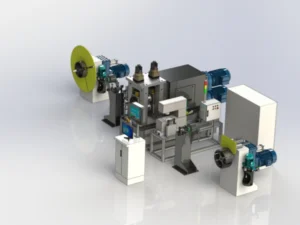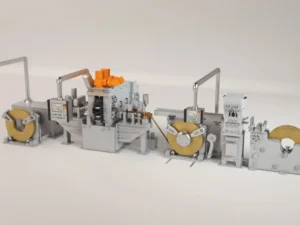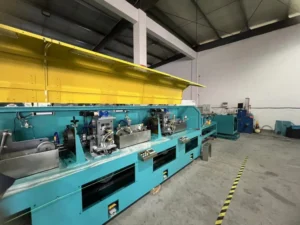
Transforming round wire into flat, rectangular, or custom-shaped profiles requires advanced wire flattening technologies that balance high accuracy, surface quality, and production speed.
For manufacturers seeking reliable, high-performance solutions, Sky Bluer China offers a full portfolio of wire flattening machines and shaping lines designed for diverse industries, from transformers and medical devices to automotive and industrial applications.
What Is Wire Flattening?
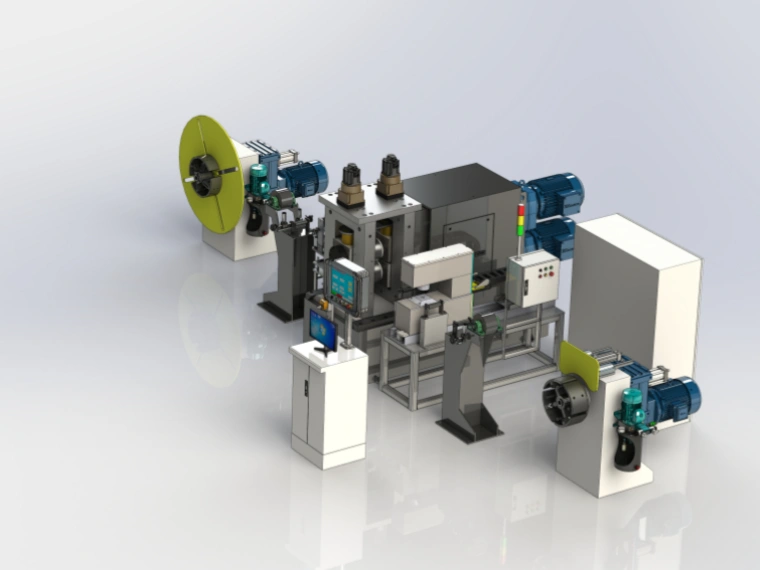
Wire flattening reshapes round wire into flat or shaped profiles through controlled rolling deformation. Unlike wire drawing, which focuses on diameter reduction and mechanical strengthening, wire flattening ensures precise geometry, surface integrity, and dimensional stability, making it essential for:
- Transformer winding conductors
- Stainless steel strips for industrial applications
- Specialty nickel-titanium wires for medical or orthodontic use
Key Objectives of Wire Flattening
- Accurate width and thickness control
- Consistent profile geometry
- Smooth surface finish suitable for insulation or coating
- Minimal internal stress and work hardening
Core Technologies Behind Wire Flattening Machines

Sky Bluer China’s machines integrate multiple advanced technologies.
1. High-Rigidity Mechanical Frame
- Minimizes vibration and elastic deformation during high-speed rolling
- Ensures stable roll pressure across multi-pass operations
2. Precision Roll Tooling
- Hardened alloy steel or tungsten carbide rolls
- Optimized roll geometry for minimal stress and uniform thickness
- Long service life for high-strength and specialty materials
3. Multi-Pass Deformation Process
- Gradual wire shaping to preserve material integrity
- Maintains flatness and width accuracy across longer production runs
4. Intelligent Control Systems
- Servo-driven roll gap adjustments
- Tension control and closed-loop feedback
- Real-time monitoring for consistent output and minimal scrap
Wire Flattening Machine Types by Sky Bluer China

1. Copper Flat Wire Rolling Mills for Transformers
Applications: Power transformers, distribution transformers, motor windings
Technical Specifications:
- Finished width: 2–20 mm
- Finished thickness: 0.1–1.2 mm
- Thickness tolerance: ±0.02 mm
- Flatness: ≤0.05 mm per meter
- Production speed: up to 60 m/min
Key Features:
- Multi-stand rolling for gradual, controlled deformation
- Surface finish optimized for insulation coating (enamel or paper)
- Tension-controlled take-up to prevent deformation and maintain geometric stability
Advantages:
- High filling factor in transformer windings
- Reduced electrical loss due to consistent cross-section
- Minimal internal stress for long-term reliability
2. Stainless Steel Edge Flat Strip Production Lines
Applications: Automotive components, industrial springs, structural strips
Technical Specifications:
- Finished width: 3–30 mm
- Finished thickness: 0.2–2.5 mm
- Thickness tolerance: ±0.03 mm
- Edge burr: ≤0.05 mm
- Production speed: up to 50 m/min
Key Features:
- Multi-stand rolling for precise width and thickness control
- Adjustable roll configurations for edge precision
- Integrated flatness measurement system for continuous quality control
Advantages:
- High flatness and edge quality
- Suitable for high-strength stainless steel grades
- Flexible for small batch or continuous production
3. Nickel-Titanium (NiTi) Square Wire Production Lines
Applications: Orthodontic wires, medical devices, precision engineering components
Technical Specifications:
- Finished width/height: 0.3–2.0 mm (square cross-section)
- Dimensional tolerance: ±0.01 mm
- Surface finish: Mirror-like for coating and biocompatibility
- Production speed: up to 30 m/min
Key Features:
- Specialized roll materials to prevent NiTi adhesion
- Multi-pass shaping to reduce work hardening
- Servo-driven control for precise square and rectangular profiles
Advantages:
- Exceptional repeatability for high-precision medical applications
- Maintains shape-memory and elasticity of NiTi
- Minimal residual stress for device safety and performance
4. Turks Head Wire Flattening Mills
Applications: Custom-shaped wire profiles, industrial and structural wire products
Technical Specifications:
- Rollable wire width: 2–25 mm
- Thickness: 0.2–3 mm
- Flatness: ≤0.05 mm per meter
- Profile tolerance: ±0.02 mm
For those in need of a turnkey system solution for wire drawing and rolling machines, please contact us.
Key Features:
- Four-roll configuration for multi-directional shaping
- Adjustable roll angles for flat, square, or custom profiles
- Compatible with various metals including copper, stainless steel, and specialty alloys
Advantages:
- Flexible shaping capability for diverse production needs
- High geometric symmetry and consistency
- Can integrate into continuous production lines
5. Compact and Customized Wire Flattening Units
Applications: Limited space workshops, small-batch production, integrated turnkey lines
Technical Specifications:
- Flattening width: 2–15 mm
- Thickness: 0.1–1 mm
- Production speed: up to 40 m/min
Key Features:
- Space-efficient design integrating payoff, flattening, guiding, and take-up
- Customizable for integration with drawing machines, annealing, or coating systems
- Servo-driven adjustments for repeatable precision
Advantages:
- High flexibility for diverse production requirements
- Easy installation in compact factory layouts
- Reduced handling and faster changeovers
Applications Across Industries

Sky Bluer China’s wire flattening solutions are used across multiple sectors:
- Electrical and Electronics: Transformer copper wire, conductive strips, motor windings
- Medical and Orthodontics: NiTi wires, precision square wires
- Automotive and Industrial: Springs, structural components, stainless steel strips
- Energy and Infrastructure: High-performance conductors, specialty alloy profiles
Benefits of Advanced Wire Flattening Machines

- High accuracy and repeatability: Ensures consistent output and reduces scrap
- Precision surface quality and profile control: Suitable for coating or insulation
- Process stability and efficiency: Multi-pass deformation and automation minimize operator intervention
- Lower total cost of ownership: Optimized design reduces maintenance, energy consumption, and downtime
Conclusion
From producing transformer copper flat wire to stainless steel edge strips and nickel-titanium square wires, mastering wire flattening and drawing requires a combination of mechanical design, precision tooling, and intelligent control systems.
Sky Bluer China, as a leading manufacturer and supplier in China, provides a comprehensive portfolio of wire flattening machines and customized shaping solutions. With detailed control over dimensions, flatness, and surface quality, Sky Bluer China’s machines help manufacturers achieve precision, efficiency, and long-term cost-effectiveness across a variety of industrial applications.
Contact Sky Bluer China
-
Phone / WhatsApp: +86 136 4191 9128
-
Email: drawingmachine66@gmail.com
-
Address: Suzhou City & Zhangjiagang City, Jiangsu Province, China