Skip to content
What Is a Wire Rolling Mill and How It Works
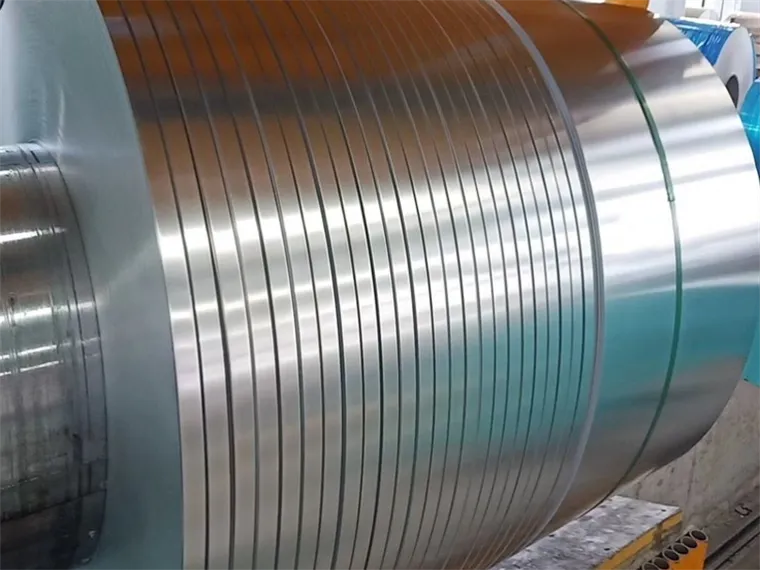
A wire rolling mill is industrial equipment designed to transform round wire rods into flat wire profiles with controlled thickness, width, and R angle edges. Unlike drawing-only processes, rolling applies gradual deformation through calibrated rolling stands, preserving the metal’s grain structure while achieving tighter tolerance control.
The complete production process includes:
- Pay-off and straightening
- Multi-pass rolling
- Edge forming with controlled R angle
- Surface smoothing
- Cooling filtration system
- Continuous automatic control gauge
- Automatic recoiling
Modern systems integrate PLC control, servo synchronization, and closed-loop tension adjustment. This ensures consistency when producing flat wire for door hinges, sliding door rails, and window frame reinforcement strips.
For manufacturers producing 304 stainless steel flat wire or high carbon steel flat wire, stable rolling pressure and temperature management are critical for long-term mechanical performance.


Flat Wire Materials Suitable for Door & Window Hardware
Material selection directly determines the durability, corrosion resistance, strength, and cost efficiency of hardware products. Our wire rolling mills are compatible with a wide range of metal materials.
Stainless Steel (304, 316, 316L,321,430)
304 stainless steel is widely used for indoor and standard outdoor applications due to its excellent corrosion resistance and mechanical stability.
316 stainless steel contains molybdenum, offering superior resistance to salt spray and humid environments. It is ideal for coastal regions and high-end sliding door systems.
430 stainless steel provides a more economical solution and is commonly used for window fittings and structural accessories.
Carbon Steel
Carbon steel offers high strength and good formability. Low-carbon steel is suitable for components requiring bending and forming, while high-carbon steel provides tensile strength up to 800 MPa, making it ideal for lock cores and load-bearing parts.
Iron Flat Wire
Iron is typically used for budget-oriented hardware products. It requires surface treatments such as galvanizing or painting to prevent corrosion. It is suitable for non-critical components such as basic window latches and simple handles.
Our rolling mills process both hot-rolled and cold-rolled wire rods while maintaining precise dimensional control and consistent mechanical properties.


Key Technical Requirements for Flat Wire Hardware Production
Door and window hardware operates under repeated mechanical stress, environmental exposure, and precision assembly demands. Below are the critical technical requirements, including typical finished product dimensions and material specifications:
Core Technical Standards
Thickness tolerance: ±0.005–0.05 mm
Width tolerance: ≤±0.10 mm
Surface finish: Rz3.2–Rz0.8, smooth and burr-free
Tensile strength: 520–800 MPa depending on material
Edge radius (R angle): 0.2–1.5 mm
Corrosion protection: passivation, galvanizing, or coating
Accurate R angle control improves assembly safety and prevents stress concentration. High surface quality eliminates secondary polishing processes and reduces production costs.
Typical Finished Product Specifications
Hardware Type | Material | Thickness (mm) | Width (mm) | R Angle (mm) |
Flat Wire for Door Hinges | 304/316 Stainless Steel | 2.0–5.0 | 8–30 | 0.5–1.2 |
Flat Wire for Sliding Door Tracks | 304 Stainless Steel | 3.0–8.0 | 15–50 | 0.8–1.5 |
Flat Wire for Door Handles | 304 Stainless Steel/Carbon Steel | 2.5–4.0 | 10–25 | 0.3–0.8 |
Flat Wire for Window Fittings | 430 Stainless Steel/Carbon Steel | 1.5–3.0 | 6–20 | 0.2–0.6 |
Flat Wire for Lock Components | High-Carbon Steel | 1.0–2.5 | 5–15 | 0.2–0.5 |
Model CRM2026-SD Precision Wire Rolling Mill
The CRM2026-SD is a five-stand precision flat wire rolling mill designed for medium to high-volume hardware production. It converts round wire into flat wire with excellent dimensional consistency and edge quality.
Key advantages include:
Thickness tolerance up to ±0.005 mm
Servo motor drive system
PLC automatic control
Adjustable tension system
Automatic edge rolling and take-up
The production capacity reaches 500–800 kg per hour, making it suitable for continuous industrial operation. Optional features such as online annealing and automatic lubrication enhance ductility and extend roll service life.
This flat wire rolling machine model is ideal for manufacturing door hinges, sliding tracks, handles, lock components, and window frame accessories.
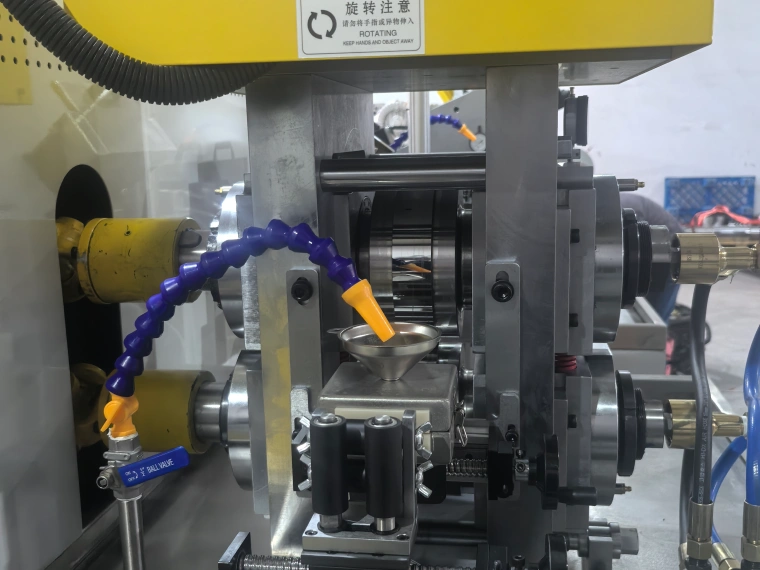
Stainless Steel Wire Rolling Mill For Sliding Doors
Our stainless steel wire rolling mill for sliding doors is optimized for producing high-strength sliding track strips and roller guide components.
Typical finished dimensions:
Thickness: 3.0–8.0 mm
Width: 15–50 mm
R angle requirement: 0.8–1.5 mm
Tensile strength: ≥600 MPa
The system stabilizes rolling pressure to ensure consistent production of stainless steel flat wire for window and door hardware. Intermediate annealing improves flexibility while maintaining structural strength.
Multi Stand Wire Rolling Mill for Door Handles
In addition to single-stand machines, we supply multi stand wire rolling mill for door handles. These 3–7 stand continuous rolling systems ensure gradual deformation and superior dimensional accuracy.
Typical flat wire for door handles:
Thickness: 2.5–4.0 mm
Width: 10–25 mm
R angle: 0.3–0.8 mm
Materials: 304 stainless steel, low-carbon steel
Our precision wire rolling mill for door hinges and handles maintains synchronized roll speed (±0.1 mm/s) and automatic tension balancing. The modular structure allows quick roll replacement for different handle designs.

High Precision Flat Wire Rolling Mill for Window Fittings
Window fittings require ultra-precise flat strips for compact assemblies. Our high precision wire rolling mill for window fittings achieves thickness tolerance within ±0.008 mm.
Production range:
Thickness: 1.5–3.0 mm
Width: 6–20 mm
R angle: ≥0.2 mm
Diamond-polished rolls improve surface finish (Rz≤0.8). This machine functions as an industrial wire rolling mill for window accessories, suitable for large-scale production lines.

Custom Wire Rolling Mill Solutions
Every hardware factory has different dimensional and capacity requirements. We design custom wire rolling mill for door and window production based on:
Special stainless steel grades
Carbon steel flat wire profiles
Non-standard R angle designs
Online annealing integration
Capacity from 100 kg/h to 1000+ kg/h
Our automated wire rolling mill for door and window manufacturing integrates PLC, servo motors, and real-time monitoring systems to reduce labor and improve stability.
Conclusion
We are a professional manufacturer of wire rolling mill systems in China. Our product range covers:
Wire rolling mill for window and door hardware
Precision wire rolling mill for door hinges
Flat wire rolling mill for window frames
Stainless steel wire rolling mill for sliding doors
Multi stand wire rolling mill for door handles
High precision wire rolling mill for window fittings
All equipment complies with European CE and American UL certification standards. We provide complete rolling mill solutions, including installation, commissioning, training, and long-term technical support.
Contact us today to request technical specifications or a custom quotation.
Frequently Asked Questions
What is a wire rolling mill used for in window and door hardware production?
A wire rolling mill converts round wire rods into stainless steel flat wire or carbon steel flat wire used in hinges, sliding tracks, window frames, and lock components.
What makes a precision wire rolling mill for door hinges different?
It maintains tighter thickness tolerance (±0.005 mm) and accurate R angle control to ensure hinge alignment and load-bearing stability.
Can your stainless steel wire rolling mill for sliding doors process 316 material?
Yes. The machine is designed to handle both 304 and 316 stainless steel flat wire for high-corrosion environments.
Do you offer a multi stand wire rolling mill for door handles?
Yes. Our multi stand wire rolling mill for door handles uses sequential rolling stands to improve flatness and dimensional consistency.
What materials can a flat wire rolling mill for window frames process?
It can process carbon steel flat wire for window frames and stainless steel flat wire for reinforcement structures.
Is your system suitable as an industrial wire rolling mill for window accessories?
Yes. High-capacity models support continuous production for large-scale window accessory manufacturers.
Can the equipment operate as an automated wire rolling mill for door and window manufacturing?
Yes. The system includes PLC automation, servo drives, and real-time monitoring for stable automated production.
Do you provide custom wire rolling mill for door and window production?
We design custom wire rolling mill solutions based on material type, required flat wire dimensions, and production capacity.