 Skip to content
Titanium and its alloys are highly valued in industries ranging from aerospace and medical devices to electronics and welding applications. Their excellent strength-to-weight ratio, corrosion resistance, and biocompatibility make them ideal for precision components, structural parts, and specialized wire products. However, producing titanium wire, titanium alloy wire, and titanium welding wire requires advanced machinery designed to handle these materials’ unique properties.
This article explores the best machine models for producing titanium wire and its alloys, explains the technology behind them, highlights their advantages, and provides guidance for sourcing from a reliable manufacturer or supplier in China.
Understanding Pure Titanium Wire, Titanium Alloy Wire, and Titanium Welding Wires
Titanium wire comes in several forms, each designed for specific industrial applications. Pure titanium wire is made from commercially pure titanium, offering excellent corrosion resistance, lightweight strength, and biocompatibility. It is commonly used in medical devices, aerospace components, and chemical equipment where purity and corrosion resistance are critical.
Titanium alloy wire combines titanium with other metals such as aluminum, vanadium, or molybdenum to enhance strength, fatigue resistance, and thermal stability. This makes it ideal for aerospace fasteners, springs, and high-performance industrial components. The alloying process allows manufacturers to tailor mechanical properties to specific engineering requirements.
Titanium welding wire is specially produced for use in TIG (Tungsten Inert Gas) or MIG (Metal Inert Gas) welding applications. It must meet strict standards for ductility, surface cleanliness, and consistency, ensuring high-quality welds for titanium structures in aerospace, medical, and chemical industries. Hot or cold drawing machines designed for titanium wires are typically used to produce welding wire with precise diameter, smooth surface finish, and reliable mechanical properties.
Understanding the differences between these types of titanium wire helps manufacturers and engineers select the right machine, process, and material for each application, ensuring optimal performance and product reliability.
Key Features of Machines for Titanium Wire

High-Precision Drawing Dies
Titanium is prone to surface defects if the die quality is insufficient. High-performance machines use tungsten carbide or high-strength tool steel dies that maintain dimensional accuracy while minimizing wear. Multi-stage dies allow gradual diameter reduction, ensuring smooth surfaces and precise tolerances.
Controlled Heating and Cooling Systems
For hot drawing or combined hot/cold drawing, precise temperature control is critical. Modern machines use preheating furnaces, induction heating, and controlled cooling zones to avoid cracking, surface oxidation, or microstructural damage. Proper heating improves ductility and reduces stress during wire deformation.
Servo-Driven Speed and Tension Control
Maintaining consistent tension and drawing speed is essential when processing titanium alloys. Servo motors and automated tension systems prevent wire breakage, uneven diameter, or surface scratches, ensuring continuous high-quality output.
Multi-Stage Reduction Capability
Most high-quality titanium wire machines are multi-pass or tandem designs, allowing gradual diameter reduction across multiple dies. This approach reduces internal stresses, improves mechanical properties, and ensures uniform wire diameter.
Integrated Lubrication
Titanium drawing requires specialized lubricants, typically oil-based or synthetic, to reduce friction and protect both the die and the wire. Many machines feature automatic lubrication systems combined with cooling to enhance die life and surface quality.
Types of Machines Suitable for Titanium Wire

Multi-Die Wire Drawing Machines
These machines feature multiple drawing dies arranged in series, allowing gradual reduction of wire diameter. Multi-die machines are ideal for fine titanium wires used in medical devices, electronics, or precision engineering.
Hot Drawing Machines
Hot drawing machines preheat titanium wire to improve ductility before it passes through dies. This approach reduces brittleness and breakage, especially when working with high-strength titanium alloys. Hot drawing is often combined with annealing and controlled cooling to optimize mechanical properties.
Continuous Tandem Drawing Machines
Continuous tandem machines integrate preheating, drawing, cooling, and coiling into a single production line. This design maximizes efficiency, maintains uniform quality, and is suitable for medium-to-large-scale production of titanium wire and welding wire.
Wire Flattening and Shaping Machines (Optional)
For specialized applications such as rectangular or flat titanium wire, additional flattening and shaping machines are integrated after the drawing process. These machines preserve mechanical properties while producing custom cross-sectional shapes.
Cold Drawing Machines
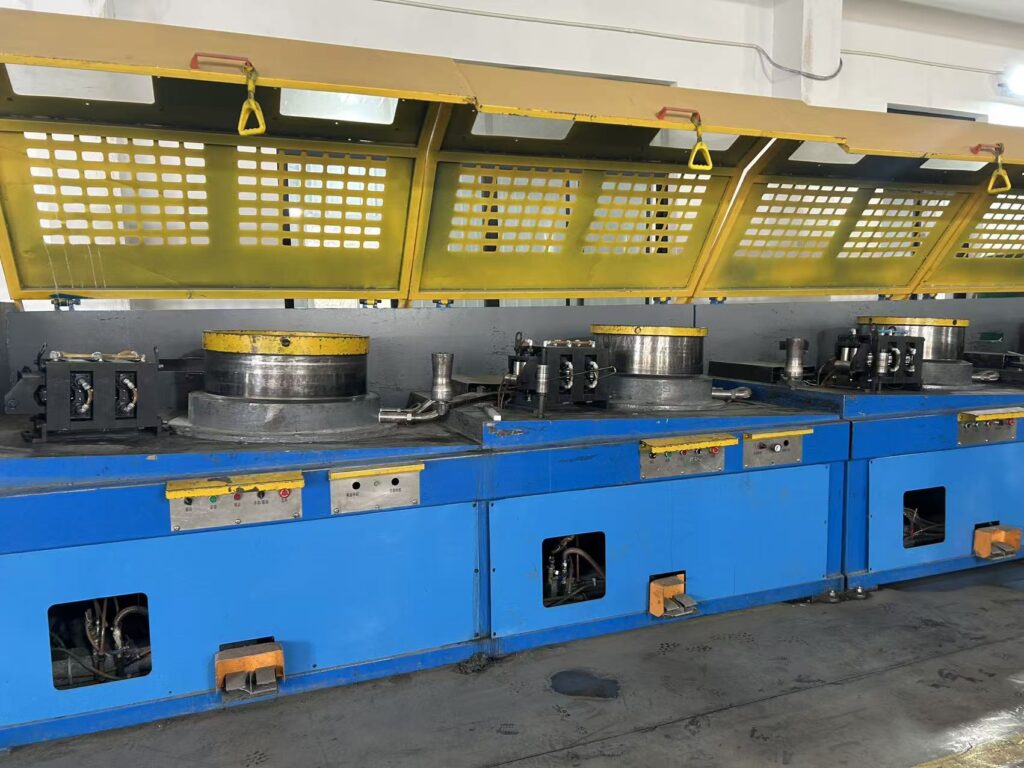
Cold drawing machines are essential equipment for producing high-precision TI wires and strips at room temperature. By pulling metal through a series of precision dies, these machines reduce the diameter of wire while improving surface finish, mechanical strength, and dimensional consistency.
In China, this type of cold drawing machine has become the preferred choice for TI wire manufacturers, capturing over 60% of the domestic market. Its combination of reliability, precision, and adaptability makes it highly favored among both small and large-scale producers. Chinese manufacturers have continuously improved the design, incorporating servo-driven systems, automated tension control, and multi-pass die configurations, ensuring stable production of high-quality wire. As a result, cold drawing machines dominate the wire processing industry in China, serving as a benchmark for performance and efficiency in both domestic and export markets.
Applications of Titanium Wire and Welding Wire

Titanium wire produced on these machines finds applications in:
- Aerospace and aviation – lightweight, high-strength components
- Medical devices – surgical instruments, implants, and dental wires
- Electronics – connectors and precision components
- Welding applications – titanium welding wires for high-performance joints
- Industrial springs and fasteners – corrosion-resistant, high-strength wire
The ability to process both pure titanium and titanium alloys allows manufacturers to meet diverse industry requirements.
Advantages of Using High-Quality Machines

Investing in the best machine models offers several benefits for titanium wire production:
- Consistent Dimensional Accuracy – Multi-pass dies and servo controls ensure precise diameters.
- Superior Surface Finish – Controlled lubrication and heating prevent scratches and oxidation.
- Reduced Wire Breakage – Proper tension, speed, and thermal management minimize defects.
- High Production Efficiency – Continuous or tandem machines reduce downtime and optimize throughput.
- Material Versatility – Machines handle pure titanium, titanium alloys, and welding wire without compromising quality.
These advantages translate into reliable, high-quality products for critical applications.
Choosing the Best Manufacturer or Supplier
Selecting a trusted manufacturer or supplier is crucial. Here’s what to consider:
- Technical Expertise – Experience in designing machines for titanium and specialty metals.
- Customization Capability – Machines adapted for wire diameter, alloy type, and production volume.
- Precision and Quality – Durable frames, high-precision dies, and robust servo systems.
- After-Sales Support – Installation, operator training, spare parts, and technical guidance.
- Global Market Experience – Export experience ensures compliance with standards in the USA, Europe, and Asia.
Working with a China-based manufacturer offers cost-effective solutions, modern production capabilities, and full customization options.
Why Source Titanium Wire Machines from China?

China has emerged as a global leader in specialty wire machinery manufacturing, including titanium wire production equipment. Advantages include:
- Competitive pricing with high-quality standards
- Advanced engineering and precision manufacturing
- Customization for different titanium alloys and wire diameters
- Proven export experience to Europe, the USA, and other regions
By partnering with a reliable Chinese supplier, manufacturers gain access to high-performance machines, technical expertise, and responsive support.
Future Trends in Titanium Wire Production
As industries evolve, titanium wire machines are becoming more advanced:
- Automation and digital controls – servo drives, tension monitoring, and automatic die adjustment
- Energy efficiency improvements – optimized heating and lubrication systems
- Integrated production lines – combining preheating, drawing, annealing, and coiling
- Advanced material compatibility – handling high-strength titanium alloys and specialty welding wires
Investing in modern equipment ensures manufacturers remain competitive while maintaining high-quality output.
Differences in the Production Processes of Titanium Wire, Titanium Alloy Wire, and Titanium Welding Wire
The production processes of titanium wire, titanium alloy wire, and titanium welding wire differ mainly due to the material properties and final application requirements.
Titanium wire is typically produced from commercially pure titanium. The process often involves hot or cold drawing, where the wire is gradually reduced in diameter through precision dies. Preheating or annealing may be used to improve ductility and prevent wire breakage, while controlled lubrication and tension systems ensure high surface quality and dimensional accuracy. This process emphasizes purity and corrosion resistance, which are critical for medical, aerospace, and chemical applications.
Titanium alloy wire, such as Ti-6Al-4V, contains additional elements like aluminum and vanadium to enhance strength, fatigue resistance, and thermal stability. Producing alloy wire requires more careful temperature control and multi-pass drawing to maintain consistent mechanical properties throughout the wire. Hot drawing machines are commonly used, with integrated annealing and controlled cooling stages to achieve the required microstructure and mechanical performance.
Titanium welding wire is manufactured specifically for TIG and MIG welding applications. Its production focuses on strict diameter tolerances, surface cleanliness, and uniform mechanical properties, ensuring consistent and reliable welds. The wire is usually drawn in multiple stages and may undergo additional surface cleaning or coating processes to remove oxides and impurities that could affect welding quality.
In summary, while all three types of titanium wire share basic drawing processes, titanium alloy wire and welding wire require more precise thermal management, multi-stage reductions, and surface control to meet their specialized performance standards. Understanding these differences is essential for selecting the best machine model and manufacturer, especially when sourcing from a reliable China-based supplier.
Conclusion
Producing titanium wire, titanium alloy wire, and titanium welding wire requires specialized machinery with precision dies, temperature control, and reliable tension systems. Multi-die, hot drawing, and continuous tandem machines are among the best models for achieving high-quality, consistent wire suitable for aerospace, medical, electronics, and industrial applications.
Choosing a reputable manufacturer or supplier in China ensures access to high-performance equipment, customization, and long-term support.
Manufacturer: Sky Bluer China
Sky Bluer China is a leading manufacturer and supplier of hot and cold drawing machines, wire rolling mills, wire flattening machines, and shaping equipment. With extensive experience in producing specialty wire machinery, Sky Bluer China delivers reliable, precise, and customizable solutions for materials including titanium wire, titanium alloy wire, and titanium welding wire. For high-performance wire production and expert technical support, contact Sky Bluer China today.
Contact Us
Company: Sky Bluer China
Website: https://drawing-machines.com/
Email: drawingmachine66@gmail.com
WhatsApp: +86 136 4191 9128