 Skip to content
Automotive Engine Components and Spring Steel Flat Wire for Piston Rings
In the automotive engine components industry, piston rings are essential for sealing, heat transfer, and wear resistance. Their performance relies on spring steel flat wire with precise dimensions, uniform thickness, and controlled mechanical properties. Selecting the right wire grade—such as AISI 1075, 1095, or 65Mn—and maintaining tight tolerances ensures consistent ring fit and long-term reliability.
The flat wire forming process—including drawing, annealing, flat rolling, and stress relieving—must be carefully controlled to achieve the required cross-section, surface quality, and hardness. Proper material selection and precise process parameters prevent defects like burrs or shape deviations, guaranteeing high-performance piston rings for demanding engine applications.
Spring Steel Flat Wire Specifications and Dimensions for Piston Ring Manufacturing
Some piston ring designs require special-shaped flat or trapezoidal wire, and the forming process must accommodate these variations.
Trapezoidal wire cross-sections feature a tapered profile. The forming dies must be precision-machined to ensure accurate angles and uniform thickness. Special-shaped flat wires demand advanced roll forming techniques to shape complex geometry without compromising material integrity. Custom profiles require rigorous dimensional inspection to verify critical parameters and meet tight tolerances.
Parameter | Typical Range | Notes |
Wire Width | 1.5–6.0 mm | Depends on piston ring design |
Wire Thickness | 0.3–1.2 mm | Flat or slightly profiled cross-section |
Tolerance (Width/Thickness) | ±0.02–0.05 mm | High precision required for ring fit |
Material Grades | AISI 1075, AISI 1095, 65Mn, SUP7 | High-carbon spring steels suitable for fatigue resistance |
Surface Finish | Ra ≤ 0.8 μm | Smooth finish reduces wear and improves sealing |
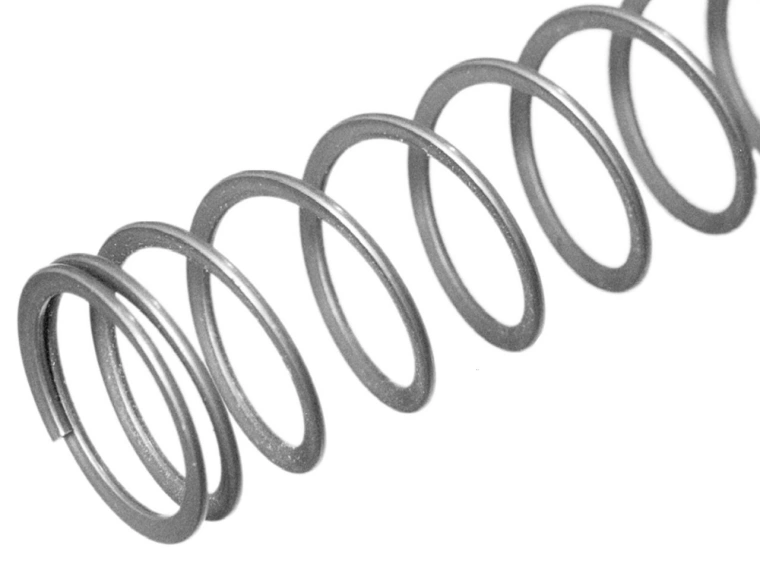
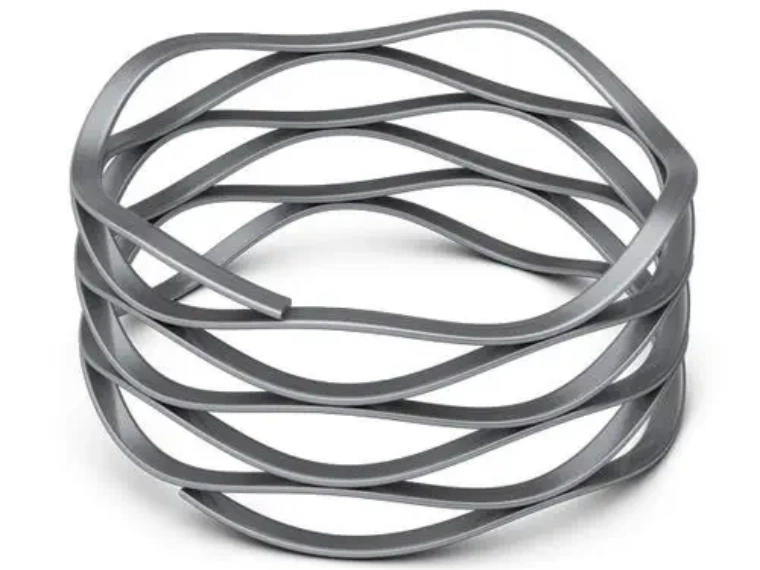
Spring Steel and Copper Flat Wire Forming Process: Drawing, Rolling, and Stress Relieving
Wire Drawing Process for Spring Steel and Copper Flat Wire
Production starts with high-carbon or spring steel round wire for high strength, fatigue resistance, and consistent strain-hardening behavior. Multi-pass wire drawing uses 4–12 continuous draw dies with 30%–50% area reduction per pass, staying below the practical safe limit to avoid fracture. Draw dies feature a bell-shaped inlet, 6°–20° approach angle, precision bearing land, and 25°–30° back relief to control diameter and reduce friction. Intermediate annealing is carried out at 0.3Tm to recrystallization temperature to restore ductility, reduce brittleness, and stabilize material properties. In-line lubrication keeps friction coefficient at 0.05–0.10 for cold drawing, protecting surface quality and lowering drawing loads.
Flat Wire Rolling and Profiling for Piston Ring Applications
Drawn round wire is converted to flat profiles by flat rolling using counter-rotating rolls. Multi-pass rolling applies controlled draft per pass, limited by friction and roll radius. 4-high rolling mills are used for precision: small work rolls reduce forming force, while large backup rolls prevent deflection and maintain uniformity. For trapezoidal or custom profiles, profiled roll grooves create near-net shape geometry. Rolling is operated under volume-constant conditions, with exit speed higher than entry speed and a stable neutral point between roll and workpiece. Dimensional tolerance is controlled within ±0.01 mm for thickness and flatness.
Stress Relieving and Hardening of Spring Steel Flat Wire
Formed parts receive thermal treatment at 0.5Tm–0.75Tm to remove residual stresses from drawing and rolling, improving fatigue life. Controlled quenching and tempering are performed in protective atmosphere to minimize surface oxidation and scale. These processes adjust hardness to HRC 45–52 and balance strength and toughness for spring and high-stress applications. Heat treatment preserves directional grain flow from forming, enhances structural stability, and avoids cracking or excessive brittleness.
Quality Control in Flat Wire Production for Piston Rings
Full-process inspection ensures compliance with strict specifications:
- Dimensional checks: Laser scanning and precision micrometers verify diameter, thickness, width, and profile symmetry; wire diameter tolerance ±0.005 mm, flat profile thickness variation ±0.01 mm.
- Mechanical properties: Tensile and hardness tests confirm yield strength, tensile strength, elongation, and target hardness range.
- Surface and defect inspection: Optical scanning detects scratches, burrs, scale, and micro-cracks; surface roughness controlled below Ra 1.6 μm.
- Internal checks exclude centerburst, piping, and inhomogeneities to ensure structural integrity and consistent performance.
Common Challenges and Solutions in Spring Steel and Copper Flat Wire Production
Thickness variation is controlled by precision multi‑pass flat rolling and closed‑loop tension monitoring to maintain tight dimensional tolerances. Surface defects such as scratches and scale are reduced by high‑performance lubrication systems and regular roll finishing and polishing. Shape deviation is corrected using profiled forming dies and real‑time laser gauging with automatic compensation. Residual stress and springback issues are relieved through stress‑relief heat treatment and springback‑compensated tool design, ensuring dimensional stability and consistent mechanical performance.
Sky Bluer Flat Wire Rolling Mill Capabilities for Spring Steel and Copper Alloys
Our flat wire production lines support diverse materials including spring steel, high-carbon alloy steel, and copper alloys, with broad compatibility across wide width, thickness ranges, and custom trapezoidal profiles. Integrated inline systems cover wire drawing, flat rolling, stress relieving, closed-loop tension control, and real-time dimensional inspection. Backed by extensive engineering experience, we deliver fully integrated production solutions including drawing systems, rolling/forming systems, and auxiliary modules such as pay-off/take-up, tension control, and online inspection. We provide full-process line design and turnkey engineering capabilities from raw material input to final precision flat wire output.
Conclusion: High-Precision Spring Steel Flat Wire Production for Piston Rings
Our solution-oriented approach and deep system integration enable stable, high-precision manufacturing for piston ring and automotive applications. With proven engineering experience across spring steel, copper, and extended dimension ranges, we provide reliable, customized production lines that support consistent quality and scalable output. Our turnkey delivery and full-process equipment design capability make us a trusted technical partner for automotive component manufacturers.