 Skip to content
Introduction: Precision Begins with the Wire
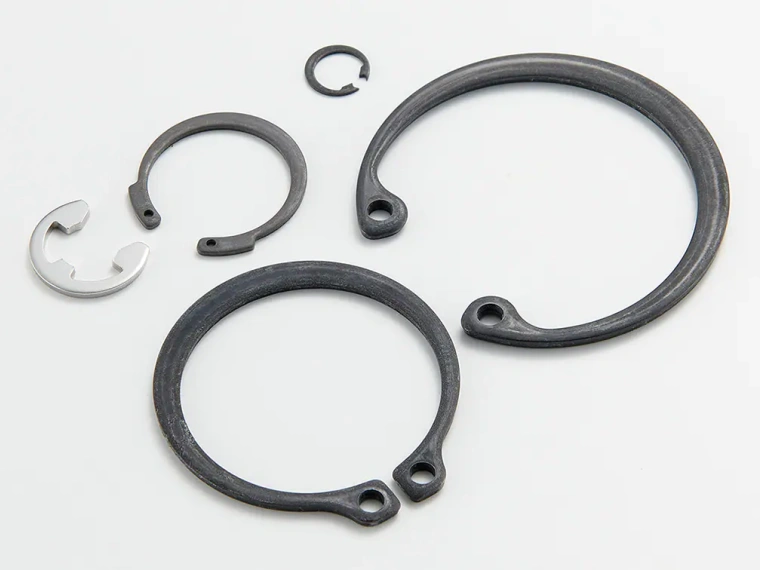
In high-performance mechanical assemblies, retaining rings—also known as snap rings, circlips, or coil rings—provide reliable axial positioning for shafts, bores, bearings, and powertrain components. While the final ring design often takes the spotlight, the upstream process that converts standard round spring wire into precision-engineered trapezoidal wire is the real foundation for consistent, high-strength rings.This article explores the complete manufacturing chain: from raw wire to trapezoidal (keystone) wire, CNC coiling, stress relief, and finishing. Emphasis is placed on engineering logic, material science, and best practices that distinguish premium rolled-and-coiled rings from low-cost stamped alternatives.
Why Trapezoidal Wire Is Critical for Retaining Rings
Unlike stamped tapered-section rings, coiled retaining rings rely on precisely controlled material flow during forming to achieve consistent dimensional stability and uniform stress distribution. The trapezoidal intermediate profile is specifically engineered to compensate for metal movement during coiling, ensuring a uniform cross-section, minimizing stress concentrations, and maintaining accurate groove fit and radial coverage. This design resists permanent diameter changes (ring set) and optimizes both thrust capacity and fatigue life.
Using trapezoidal wire also provides predictable springback, uniform hardness, and full contact with groove walls. These advantages are why leading manufacturers prefer profile wire rolling machines over drawn flat wire or stamped blanks for high-performance retaining rings.


The End-to-End Manufacturing Process
Raw Material Selection & Preparation
High-performance rings begin with certified spring wire:
- Oil-tempered high-carbon steel (ASTM A229)
- Hard-drawn carbon steel (ASTM A227)
- Chrome-silicon alloy (ASTM A401) for high-stress applications
- Stainless steel (ASTM A313) for corrosion resistance
Wire arrives in large coils, then undergoes straightening, surface cleaning, and pre-inspection. Material properties such as tensile strength, hardness, and surface finish directly impact formability and final ring performance.
Profile Wire Rolling: Round Wire to Trapezoidal Precision
The core transformation occurs in a profile wire rolling machine—a multi-stand, cold-forming system that reshapes round wire into a trapezoidal cross-section. Key engineering steps include:
- Multi-pass cold rolling: Each pass incrementally forms the trapezoid, avoiding work hardening or cracking.
- Edge shaping & calibration: Final passes refine sidewall angles and corner radii for optimal coiling.
- Tension & speed control: Dancer units maintain consistent wire tension, reducing diameter variation.
- In-line inspection: Laser micrometers monitor width, thickness, and angle to ±0.002 in (0.05 mm) tolerances.
This process produces trapezoidal wire with uniform geometry, predictable grain structure, and superior formability—critical for high-quality snap rings and retaining rings.
CNC Coiling: From Trapezoidal Wire to Retaining Ring
CNC coiling transforms trapezoidal wire into precision retaining rings. The wire is fed through high-accuracy CNC coilers and bent past its yield point, allowing the trapezoidal profile to naturally form a stable rectangular cross-section. A contoured punch then shears each ring to the exact length and desired end configuration—whether straight, butterfly, notched, or drilled. This process achieves up to 80% material savings compared to stamping, ensures consistent mechanical properties around the ring circumference, and delivers superior groove fit with enhanced load-bearing performance.
Stress Relief & Finishing
Forming introduces residual stresses that can compromise ring performance. Stress-relief processes stabilize dimensions and improve fatigue life. Optional finishing operations further enhance quality:
- Grinding: Tightens thickness tolerance to ±0.001 in (0.025 mm)
- Shot peening: Increases fatigue resistance
- Plating/coating: Provides corrosion protection
- Custom packaging: Optimized for automated assembly lines
Profile Wire Rolling Machines: Backbone of Trapezoidal Wire Production
A high-performance profile wire rolling machine is more than a shaping tool; it defines the quality of the final ring. Key features include:
- Four-high rolling mills with water-cooled tungsten carbide rolls
- Servo-controlled profile adjustment for fast die changeovers
- Integrated cleaning, polishing, and inspection
- Dancer-controlled tension for diameter consistency
- Compatibility with high-carbon, alloy, and stainless steels
These machines produce wire suitable for:
- Standard retaining rings (0.5–60 in diameter)
- Heavy-section industrial rings
- Wave rings and special bevel-section rings
- Automotive and aerospace snap rings
Trapezoidal Wire vs. Stamped & Flat-Wire Rings: Technical Comparison
Attribute | Trapezoidal Wire Coiled Ring | Stamped Tapered Ring | Flat-Wire Coiled Ring |
Cross-section consistency | Uniform, engineered | Variable | Prone to distortion |
Material utilization | High (low scrap) | Low (high scrap) | Moderate |
Stress distribution | Uniform, low concentration | High at edges | Uneven |
Thrust capacity | Predictable, high | Limited | Reduced |
Ring set resistance | Excellent | Poor | Moderate |
Applications | High-stress, precision assemblies | Light-duty, low-cost uses | General-purpose light loads |
This demonstrates why trapezoidal wire from precision profile wire rolling machines is the preferred choice for mission-critical retaining rings in automotive transmissions, aerospace actuators, industrial bearings, and heavy machinery.

Engineering Recommendations
When designing or procuring retaining rings or snap rings, it is essential to:
- Insiston coiled rings manufactured from trapezoidal keystone wire.
- Verifythat a precise profile wire rolling process is used rather than simple stamping or flat – wire
- Selectthe material to match the application, such as oil – tempered steel for high strength, stainless steel for corrosion resistance, or chrome – silicon alloys for high – stress environments.
- Specifyappropriate stress – relief operations to prevent ring set and ensure dimensional stability.
- Workwith suppliers who control the entire production chain, from wire rolling through CNC coiling, finishing, and rigorous quality testing.
Conclusion: Precision Rolling for Reliable Rings
From round spring wire to high-performance retaining rings, snap rings, and lifting rings, precision trapezoidal wire and profile wire rolling machines ensure uniform cross-section, controlled stress distribution, and superior groove fit. Combined with CNC coiling, stress relief, and finishing, this process delivers durable, high-accuracy rings that outperform stamped or flat-wire alternatives, providing reliability for automotive, aerospace, and industrial applications.
Sky Bluer China: Solving Your Wire Production Challenges
Sky Bluer China specializes in precision wire processing solutions for automotive, aerospace, and industrial applications. Our profile wire rolling machines can handle diverse wire dimensions, shapes, and materials with high accuracy and repeatability. Typical examples include:
| Product Type | Typical Size (mm) | Shape | Tolerance (mm) | Material Grades |
|---|---|---|---|---|
| Automotive Clips | 0.8 – 5.0 | Trapezoidal | ±0.03 | C11000, SUS304, Ti |
| Electrical Connectors | 1.0 – 4.5 | Rectangular | ±0.04 | C11000, SUS316, CuBe |
| Precision Springs | 1.2 – 6.5 | Square | ±0.05 | 65Mn, C17200, Ti-6Al-4V |
Our rolling mills are designed to accommodate these wire sizes, shapes, and materials efficiently. If you are in search of a flat wire rolling machine or a trapezoidal wire rolling system for high-precision applications, contact Sky Bluer China today to discuss your requirements and receive a customized solution.