 Skip to content
Importance of Copper Flat Wire in Electrical & Power Applications
In electrical and power applications, copper flat wire is crucial and irreplaceable, especially in key components like transformers, busbars, coils, and connectors, which are fundamental to electrical systems. For example, transformers use it to transfer energy, and busbars use it to distribute power. Coils and connectors also rely on it.
Several key factors are essential for copper flat wire in these applications. Firstly, high conductivity is needed to minimize resistance and energy loss, which is vital for system efficiency. Secondly, precise dimensions are critical as small variations can affect the wire’s fit and performance. Moreover, tight tolerances are necessary to meet electrical performance specifications. All these factors ensure the reliable and efficient functioning of copper flat wire in electrical and power applications.
Typical Specifications of Copper Flat Wire for Electrical Use
Typical Copper Flat Wire Specifications cover critical parameters defining its performance and application suitability. Dimensions like width (ranging from a few millimeters to several centimeters), thickness, and length are included, with thickness varying for different current – carrying and mechanical strength needs. Material composition is key, specifying copper grade such as ETP copper for good conductivity or copper alloys for enhanced mechanical properties. Electrical conductivity, measured in %IACS, is crucial, with high – purity wire achieving 97% IACS or higher. Tensile strength, showing the wire’s ability to withstand pulling, and elongation, measuring ductility, are important for bending and installation. Surface finish requires a smooth, defect – free surface to ensure insulation adherence and prevent arcing. Tolerances for all dimensions and properties are tightly controlled for consistency and interchangeability in various electrical systems.
Parameter | Typical Range | Notes |
Wire Width | 2–15 mm | For busbars and coil windings |
Wire Thickness | 0.2–2.0 mm | Depending on current rating |
Tolerance (Width/Thickness) | ±0.01–0.05 mm | Critical for uniform current distribution |
Conductivity | ≥ 97% IACS | Ensures low resistive losses |
Material Grades | C11000, C10200, Electrolytic Copper | High purity for electrical conductivity |
Surface Finish | Ra ≤ 0.6 μm | Minimizes contact resistance |

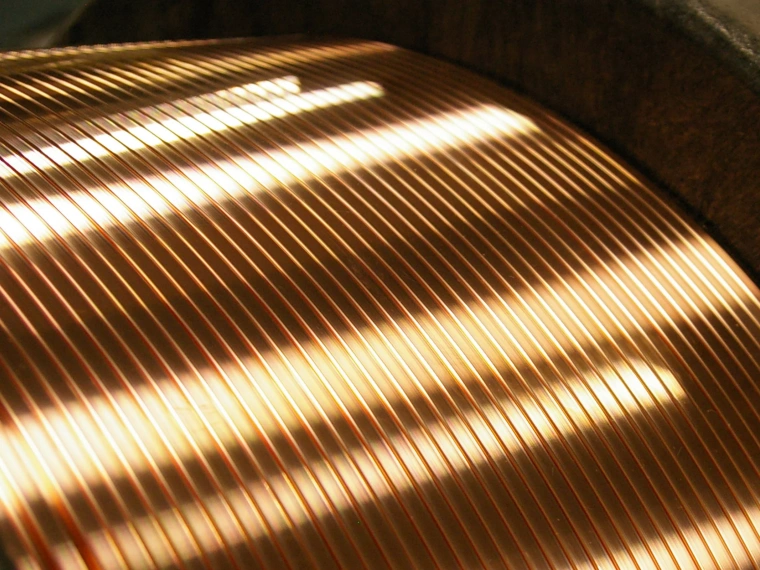
Copper Flat Wire Forming Process: From Drawing to Quality Control
Wire Drawing and Intermediate Annealing
High‑purity oxygen‑free copper rods (purity ≥99.95%) undergo multi‑pass precision drawing to target diameter under controlled tension and cooling lubrication. Intermediate stress‑relief annealing (300–500 °C) eliminates work hardening, restores ductility, and stabilizes microstructure for consistent downstream forming. Online diameter monitoring maintains dimensional stability throughout the drawing sequence.
Flat Rolling and Profile Shaping for Electrical Copper Wire
Round wire is converted to flat, rectangular, or trapezoidal profiles via multi‑stand cold rolling with precision profiling rolls. Closed‑loop thickness/width control (tolerance ±0.02 mm or better) ensures uniform cross‑section and consistent current‑carrying capacity. Optimized roll surface finish and roll gap alignment minimize surface defects, scratches, and burrs while preserving high electrical conductivity (≥97% IACS).
Post-Processing and Quality Assurance in Copper Flat Wire Production
- Optional electrolytic tinning, silver plating, or passivation enhances solderability, corrosion resistance, and terminal contact performance.
- Inline dimensional verification (thickness, width, edge radius, straightness) and precision resistance/conductivity testing validate electrical performance.
- Automated surface inspection detects scratches, burrs, oxidation, and inclusions; mechanical testing confirms elongation, tensile strength, and bend compliance.
- Final cleaning and packaging protect surface integrity for high‑reliability electrical and electronic assemblies.
Solutions to Common Challenges in Copper Flat Wire Forming
- Dimensional stability: Implement closed-loop monitoring systems integrating laser micrometers and adaptive roll pressure adjustments to maintain tight tolerance control within ±001mm.
- Surface quality enhancement: Deploy ultrasonic cleaning baths with alkaline detergents followed by hot air drying to eliminate residual lubricants, paired with electrolytic polishing for mirror-finish surfaces.
- Strain management: Utilize computer-controlled batch annealing furnaces with programmable temperature ramps (650-750°C) and nitrogen atmosphere protection to achieve uniform grain structure and consistent mechanical properties.
Sky Bluer Copper Flat Wire Rolling Mill: Production Line Capabilities
Our copper flat wire production lines provide the following capabilities:
- Compatibility with various copper grades and sizes, including wide and thin strips. This enables our system to easily handle different types and specifications of copper materials, greatly expanding its application range.
- Full integration of the entire production line, from the initial drawing process, through rolling, to tension control, and finally to in- line inspection, with all links seamlessly connected and closely coordinated. This full – process integrated production mode not only improves production efficiency but also effectively ensures product quality and stability.
- In addition, we have a strong ability to provide customized solutions for electrical and power applications. Whether it is strict control over product dimensional accuracy or careful optimization of electrical performance, we can fully meet customer needs. Throughin – depth analysis of customers’ specific application scenarios and requirements, we can tailor the most suitable product solutions for them, ensuring high product quality while helping customers achieve the best application results.
Conclusion: High-Performance Copper Flat Wire for Electrical Applications
Copper flat wire serves as a critical material for high-efficiency, high-reliability electrical and power equipment, where its forming process directly impacts conductivity, dimensional precision, and operational stability. By combining precision drawing, controlled annealing, closed-loop flat rolling, and comprehensive quality assurance, manufacturers can consistently produce wire meeting ≥97% IACS conductivity and micron-level tolerance standards. Addressing challenges such as dimensional drift, surface defects, and internal strain further improves product consistency and yield. Backed by integrated, flexible, and customizable equipment, modern copper flat wire production can fully meet the evolving demands of advanced electrical engineering, delivering stable, efficient, and long-lasting core materials for transformers, busbars, high-power coils, and other essential components.