Skip to content
Introduction
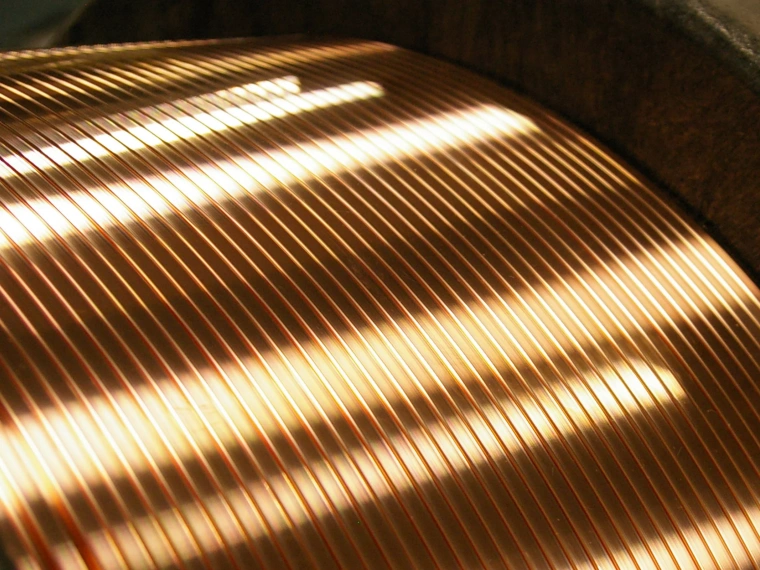
Rectangular copper wire is widely used in transformers, EV motors, generators, CTC conductors, and other high-efficiency winding applications. Compared with round wire, it provides a higher filling factor, improved thermal performance, and lower electrical losses.
However, producing high-precision rectangular wire requires much more than a rolling mill. Stable quality depends on a complete production line that integrates wire drawing, tension control, precision rolling, annealing, online inspection, and automatic take-up.
To meet the growing demand for high-accuracy flat and shaped wire production, Sky Bluer has developed the CRM2026 High-Precision Rectangular Copper Wire Production Line. Designed as a fully integrated wire drawing and rolling solution, CRM2026 delivers excellent dimensional accuracy, stable surface quality, and reliable continuous production for transformer, motor, and magnet wire manufacturers.
Typical Manufacturing Process
A typical production line follows this sequence:
Copper Rod or Round Wire → Payoff → Multi-pass Wire Drawing → Online Cleaning → Precision Rolling → Intermediate Annealing (Optional) → Laser Measurement → Take-up
Instead of concentrating deformation in one process, modern production lines distribute deformation between wire drawing and rolling. This reduces rolling force, improves dimensional consistency, and extends roll life.
Step 1: Wire Drawing – The Foundation of Precision Manufacturing
Although many manufacturers emphasize the rolling mill, precision actually begins with the wire drawing machine.
Wire drawing reduces the wire diameter while maintaining concentricity and surface quality before the rolling stage. Stable drawing minimizes rolling force and allows the rolling mill to focus on shaping the conductor rather than excessive deformation.
Advantages of Precision Wire Drawing
- Stable incoming diameter
- Excellent concentricity
- Lower rolling pressure
- Better material flow
- Improved surface finish
- Longer roll service life
- Higher production efficiency
In most precision production lines, total deformation is shared between several drawing dies and the rolling section. This balanced process reduces internal stress and improves dimensional stability.
| Item | Typical Value |
| Raw material | Oxygen-Free Copper (OFC), ETP Copper, Copper Alloy |
| Incoming wire diameter | Ø5.5–8.0 mm |
| Finished round wire before rolling | Ø1.0–4.0 mm |
| Number of drawing passes | 8–18 passes |
| Area reduction per pass | 15–25% |
| Drawing speed | 300–1200 m/min |
| Drawing die material | Tungsten Carbide / PCD / Natural Diamond |
| Diameter tolerance | ±0.005–0.010 mm |
Wire Drawing Die Selection
Drawing die material has a direct influence on wire accuracy, production speed, and operating cost.
| Die Type | Typical Application |
| Tungsten Carbide | General copper wire production |
| PCD Die | High-speed continuous production |
| Natural Diamond | Ultra-fine wire with exceptional surface quality |
Proper die arrangement and reduction ratio are equally important. Excessive reduction per pass increases drawing force and accelerates die wear, while insufficient reduction reduces productivity.
Step 2: Payoff System and Tension Control
The payoff system supplies wire continuously under controlled tension.
Modern production lines generally use horizontal reel payoffs, vertical coil payoffs, or motorized dynamic payoffs depending on coil weight and production speed.
Stable payoff tension prevents wire vibration, minimizes diameter fluctuation, and improves rolling stability.
Typical Parameters
| Item | Typical Value |
| Loading capacity | 50–1000 kg |
| Tension control accuracy | ±2% |
| Maximum line speed | 1200 m/min |
| Brake system | Pneumatic or Servo Controlled |
Step 3: Lubrication and Wire Cleaning
Lubrication is often overlooked but has a significant impact on both drawing performance and rolling quality.
A stable lubrication system reduces friction, lowers die temperature, improves surface finish, and extends tooling life.
After drawing, online cleaning removes residual lubricant before the rolling section, ensuring a clean conductor surface suitable for enamelling or paper covering.
Step 4: Precision Rolling
Rolling converts the round conductor into a flat or rectangular profile.
Unlike wire drawing, rolling mainly controls conductor geometry, including width, thickness, corner radius, and edge quality.
Machine selection depends on conductor dimensions, dimensional tolerance, and required corner radius rather than simply choosing the largest rolling mill.
Common Rolling Configurations
2-Hi Rolling Mill
Suitable for:
- Natural edge flat wire
- Medium reduction
- High production efficiency
- Simple maintenance
Turks Head (4-Roll Rolling Mill)
Suitable for:
- Precision rectangular conductors
- Better width control
- Smaller corner radius
- Higher dimensional consistency
Typical Rolling Performance
| Item | Typical Value |
| Finished width | 0.8–25 mm |
| Finished thickness | 0.20–10 mm |
| Width tolerance | ±0.003–0.020 mm |
| Thickness tolerance | ±0.002–0.010 mm |
| Surface roughness | Ra ≤0.20 μm |
| Corner radius | According to IEC / NEMA standards |
| Edge quality | Burr-free |
Step 5: Intermediate Annealing
Cold deformation increases work hardening during drawing and rolling.
Intermediate annealing restores ductility while maintaining conductor dimensions, making the wire easier to enamel, wrap, or coil.
Typical annealing temperatures range between 350°C and 650°C, depending on the copper grade and reduction ratio.
Step 6: Online Quality Inspection
Modern production lines increasingly incorporate automatic inspection systems.
Typical inspection equipment includes:
- Laser width measurement
- Laser thickness measurement
- Diameter gauge
- Surface inspection camera
- Spark tester
- Tension monitoring
- Encoder-based length measurement
Continuous monitoring allows operators to correct deviations before large quantities of material are produced.
Step 7: Automatic Take-up
The take-up system is responsible for maintaining constant winding tension while preventing scratches, deformation, and residual stress.
Available configurations include:
- Spool take-up
- Coil take-up
- Heavy-duty take-up
- Automatic traversing take-up
- Inverted take-up
Typical Parameters
| Item | Typical Value |
| Maximum spool weight | 1000 kg |
| Winding speed | Up to 1200 m/min |
| Tension accuracy | ±2% |
| Traverse control | Servo synchronized |
Critical Quality Parameters for Rectangular Copper Wire
The performance of rectangular wire is determined by several key quality indicators.
| Parameter | Typical Requirement |
| Width tolerance | ±0.003–0.020 mm |
| Thickness tolerance | ±0.002–0.010 mm |
| Surface roughness | Ra ≤0.20 μm |
| Corner radius | Customized according to standards |
| Residual stress | Low |
| Edge quality | Burr-free |
| Straightness | Excellent |
| Tensile consistency | Stable throughout the coil |
Maintaining these parameters requires coordination between wire drawing, rolling, lubrication, annealing, and tension control rather than relying on a single machine.

Common Production Challenges
Manufacturers frequently encounter:
- Width fluctuation caused by unstable drawing diameter
- Surface scratches resulting from poor lubrication
- Roll marks due to excessive rolling force
- Edge cracking caused by improper reduction ratio
- Residual stress leading to poor winding performance
- Inconsistent corner radius caused by unstable rolling pressure
Most quality issues originate upstream in the production process rather than in the rolling mill itself.
Selecting the Right Rectangular Wire Production Line
When planning a new production line, manufacturers should evaluate the complete manufacturing process rather than purchasing individual machines separately.
Important considerations include:
- Copper material grade
- Incoming wire diameter
- Finished conductor dimensions
- Annual production capacity
- Required production speed
- Corner radius specification
- Annealing requirements
- Automation level
- Future expansion capability
A fully integrated production line combines payoff, wire drawing, lubrication, precision rolling, annealing, online inspection, and take-up into one coordinated system. This approach delivers higher dimensional consistency, lower operating costs, reduced tooling consumption, and improved production efficiency.
Conclusion
A reliable rectangular copper wire production line depends on well-designed equipment working as one integrated system. The CRM2026 High-Precision Rectangular Copper Wire Production Line combines wire drawing, precision rolling, annealing, inspection, and automatic take-up to deliver stable quality, high efficiency, and consistent performance.
Whether you are launching a new project or expanding production, Sky Bluer provides customized wire drawing and flat wire production solutions tailored to your material, conductor specifications, and production requirements.